
ChatGPT for HR: My 5 Custom GPTs for tangible results
AI won’t replace HR. But HR professionals who use AI will replace those who don’t.

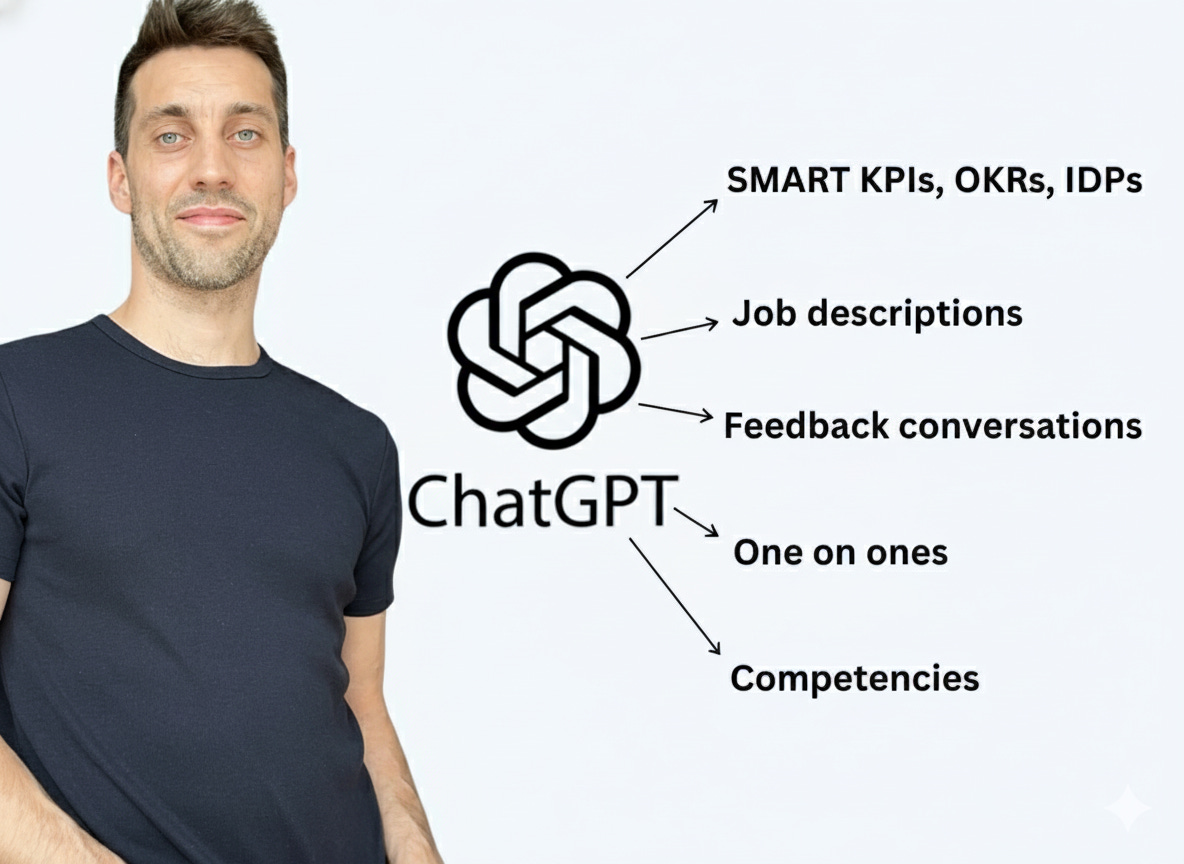
The illusion of “AI in HR”
Everyone is talking about AI in HR.
Vendors claim to “revolutionize HR with AI.” CEOs post about “future-ready workforces.”
And yet inside HR teams nothing much changes.
In this article i am not talking about AI systems for HR. I’ll only go through how “chatgpt” can help you win some time to crunch some work that you may not want to do yourself.
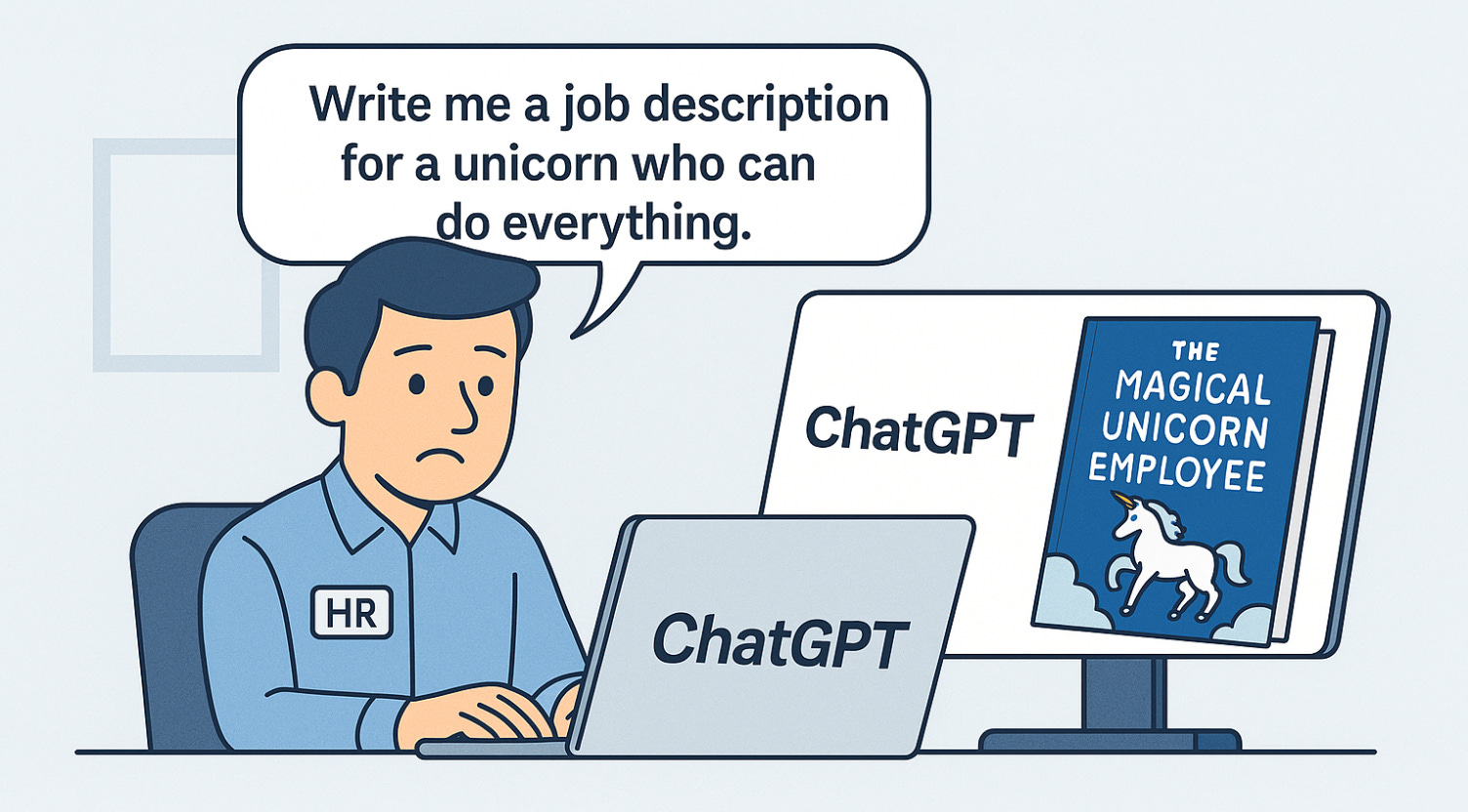
Most HR professionals open ChatGPT once, type a question like “Write me a job description for a sales manager”, get a bland result, and think: “This isn’t for me.”
But the problem isn’t ChatGPT. It’s how HR uses it.
If you treat ChatGPT like Google, you’ll get generic answers.
If you treat it like an intern, someone who needs context, structure, and feedback you’ll get real value.
ChatGPT for HR isn’t about replacing your work although yes, we should all be concerned about the AI in our jobs. Moving forward I strongly believe we will need “less HR headcounts”, but we’ll still need HR.
My view is that AI on the short terms will help refocus HR to added value tasks. I previously took the example of the Talent acquisition specialist to highlight this point:
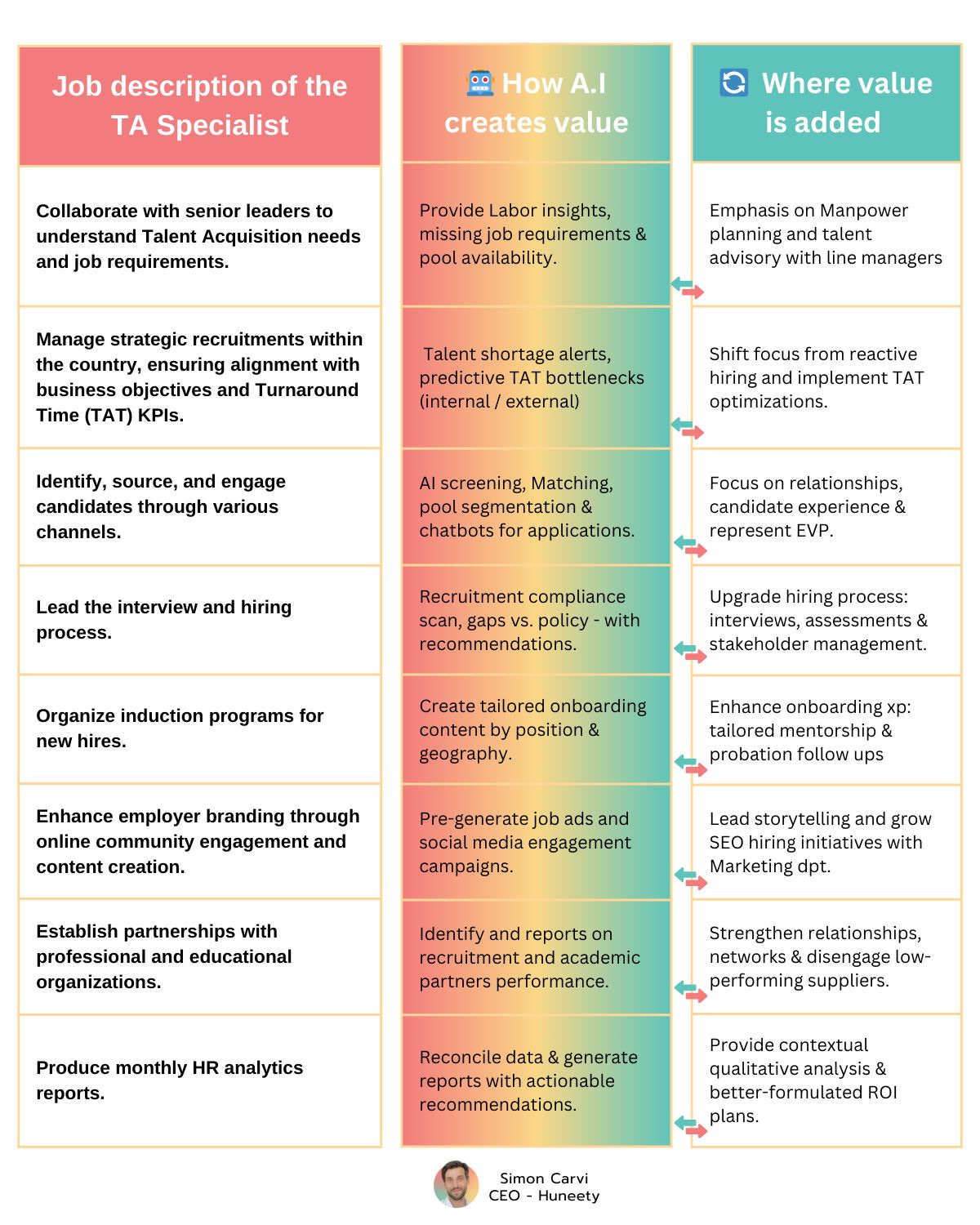
When it comes to the use of GPT for HR, you can use it to spend less time writing and more time thinking. In summary, Less formatting, more decision-making.
What can ChatGPT do for HR?
Let’s start with the simple question HR people ask me most:
“What exactly can ChatGPT do for HR?”
Here’s the short answer: a lot more than you think.
ChatGPT can:
Write or refine job descriptions that sound like your company, not a textbook.
Draft KPIs, OKRs, and IDPs that are actually measurable.
Generate interview questions aligned with your competencies.
Summarize 360° feedback or exit interviews in clear language.
Help managers prepare one-on-one conversations.
Suggest learning plans and coaching approaches.Translate your HR jargon into something business leaders actually understand.
And it does all that in seconds, if you know how to ask the right question.
That’s where prompts and custom GPTs come in.
How HR can use ChatGPT daily
Let’s make it practical.
Imagine this: you have two job openings, a manager needs a performance plan, and you’re late for a 1:1.
Here’s how ChatGPT can save your day:
Morning:
🕗 9:00 AM – Recruitment
Ask ChatGPT: “Rewrite this job description in a way that attracts mid-level candidates, not executives.”
→ Done. XXX minutes saved.
Late morning:
🕙 11:00 AM – Performance review prep
Ask: “Summarize this employee’s feedback in 5 key points, tone: constructive but firm.”
→ Draft ready before your call.
Afternoon:
🕒 3:00 PM – Manager coaching
Ask: “Help me prepare a 1:1 with an employee who’s underperforming due to motivation.”
→ ChatGPT gives you talking points, questions, and what to avoid saying.
End of day:
🕕 6:00 PM – Learning follow-up
Ask: “Turn these training takeaways into a simple SMART action plan template.”
→ You just created a practical follow-up tool.
That’s ChatGPT at its best: a work accelerator for some pre-identified tasks, not a work replacement.
⚙️ My 5 Custom GPTs for HR
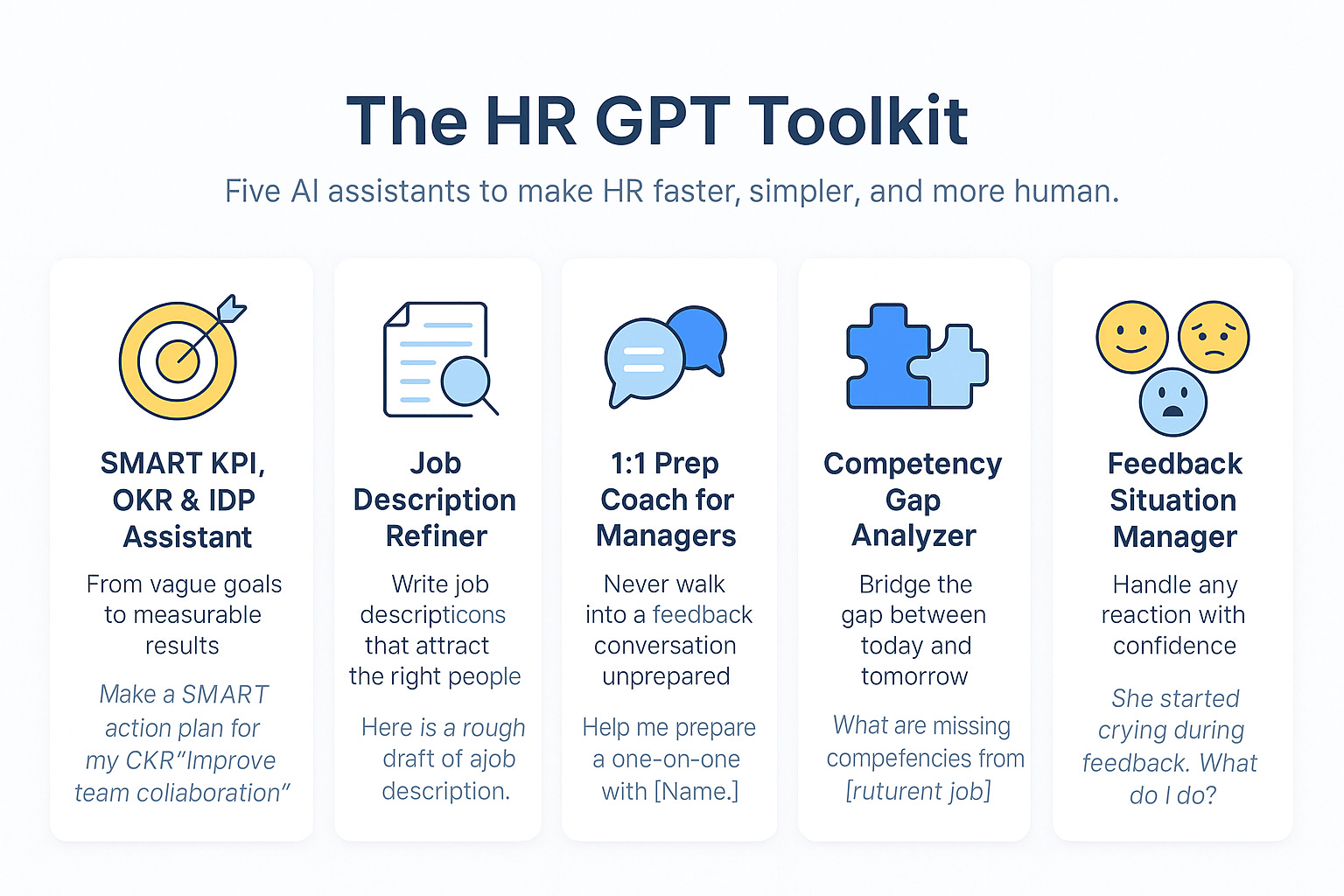
To develop my manager development program I’ve built my own custom GPTs. Each designed to make Managers and HR actually usable in real life.
Here’s how they work and how you can use them today.
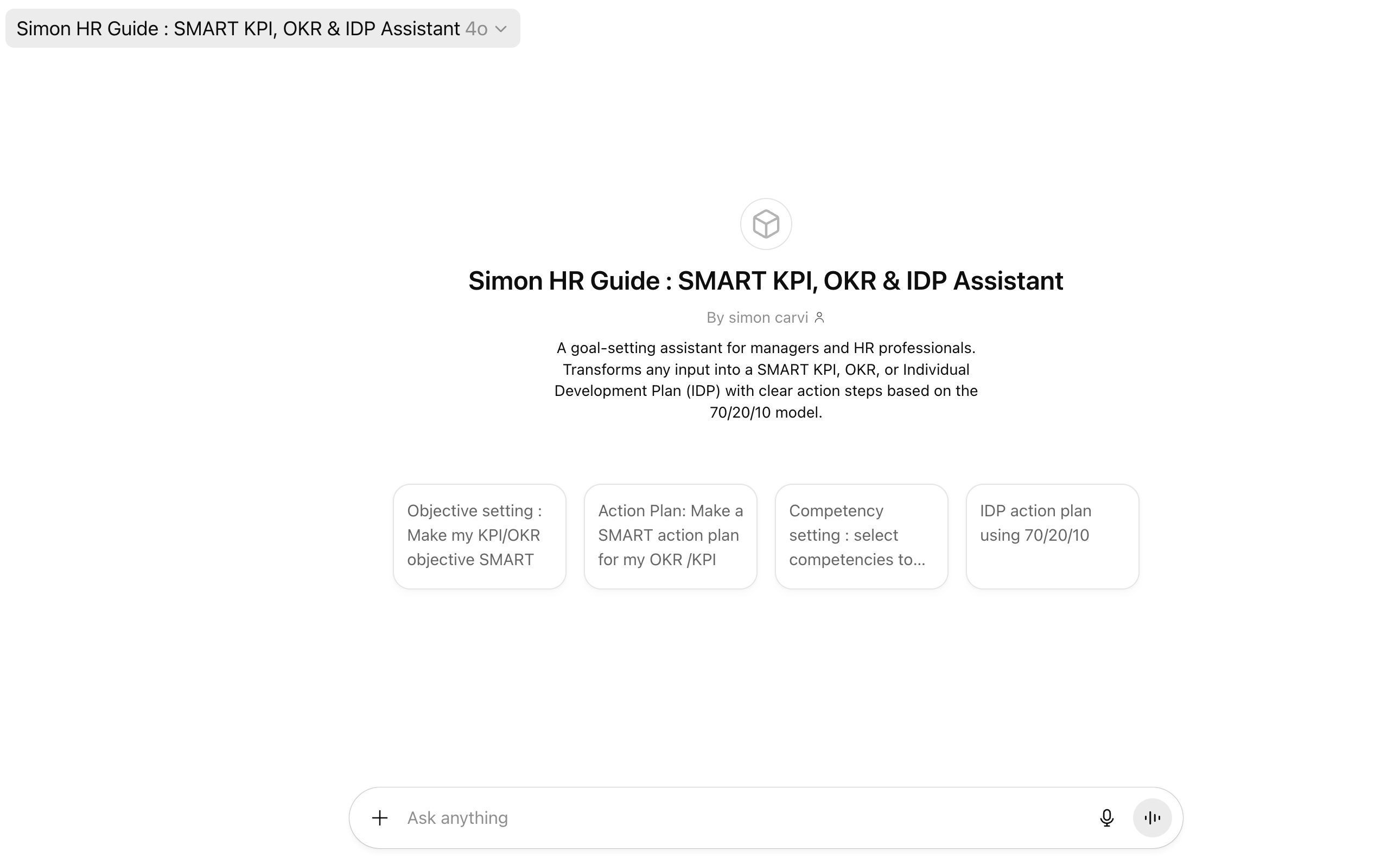
1️⃣ Simon HR Guide: SMART KPI, OKR & IDP Assistant
ChatGPT for SMART goals, OKR, IDP, performance planning
If you’ve ever stared at a KPI template thinking, “What does ‘measurable’ even mean here?”—this is for you.
This GPT helps HR professionals and managers translate business objectives into SMART goals.
It also builds Individual Development Plans (IDPs) that connect growth to performance, not just wish lists.
Example prompt:
“Action Plan: Make a SMART action plan for my OKR ‘Improve team collaboration’.”
Example output:
Specific: Run a monthly cross-department meeting.
Measurable: 90% attendance rate across departments.
Achievable: Limited to 60 minutes.
Relevant: Supports company initiative “Better Together.”
Time-bound: 3-month pilot.
Then it gives a learning recommendation for each goal.
It’s the perfect mix of structure and initiative.
Use it when:
You’re setting annual KPIs.
You need to coach managers on goal-setting.
You’re building a performance review form that doesn’t suck.
👉 Here is the link to the SMART KPI, OKR & IDP Assistant 👈
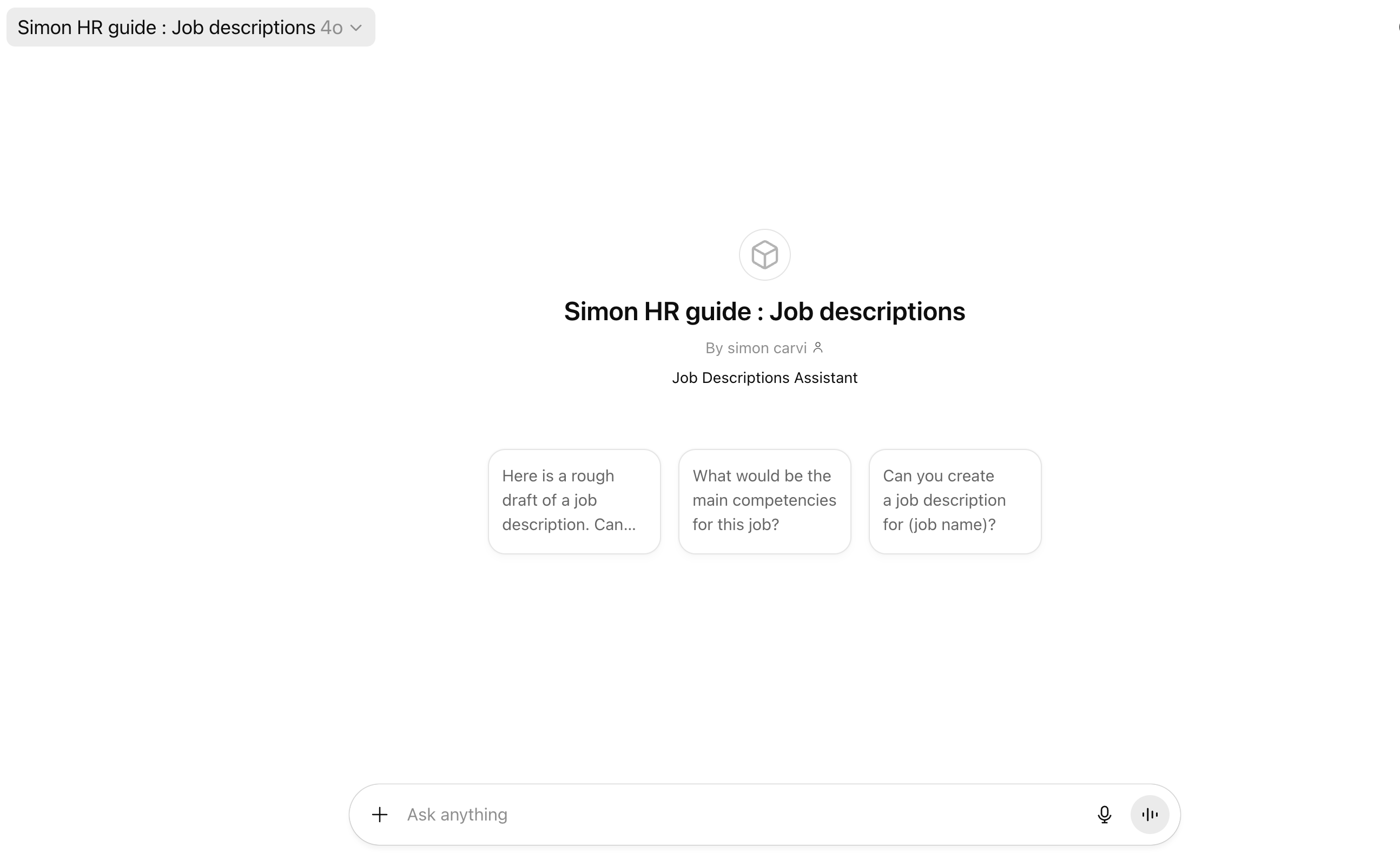
2️⃣ Simon HR Guide: Job Description Refiner
ChatGPT for job descriptions and recruitment
Let’s be honest: most job descriptions are terrible.
They’re written once, never updated, and filled with “dynamic team player” clichés.
This GPT helps HR rewrite job descriptions that:
Reflect actual business needs.
Use plain, human language.
Are optimized for job boards.
Example prompt:
“Here is a rough draft of a job description for a Production Engineer. Can you refine it?”
Example output:
It identifies missing competencies, adds behavioral skills, and suggests KPIs.
You get a clean, structured job description ready for posting—or internal mobility.
Use it when:
Managers send you half-written JDs.
You’re standardizing job families.
You need quick updates for job boards.
👉 Here is the link to the GPT job description Assistant 👈
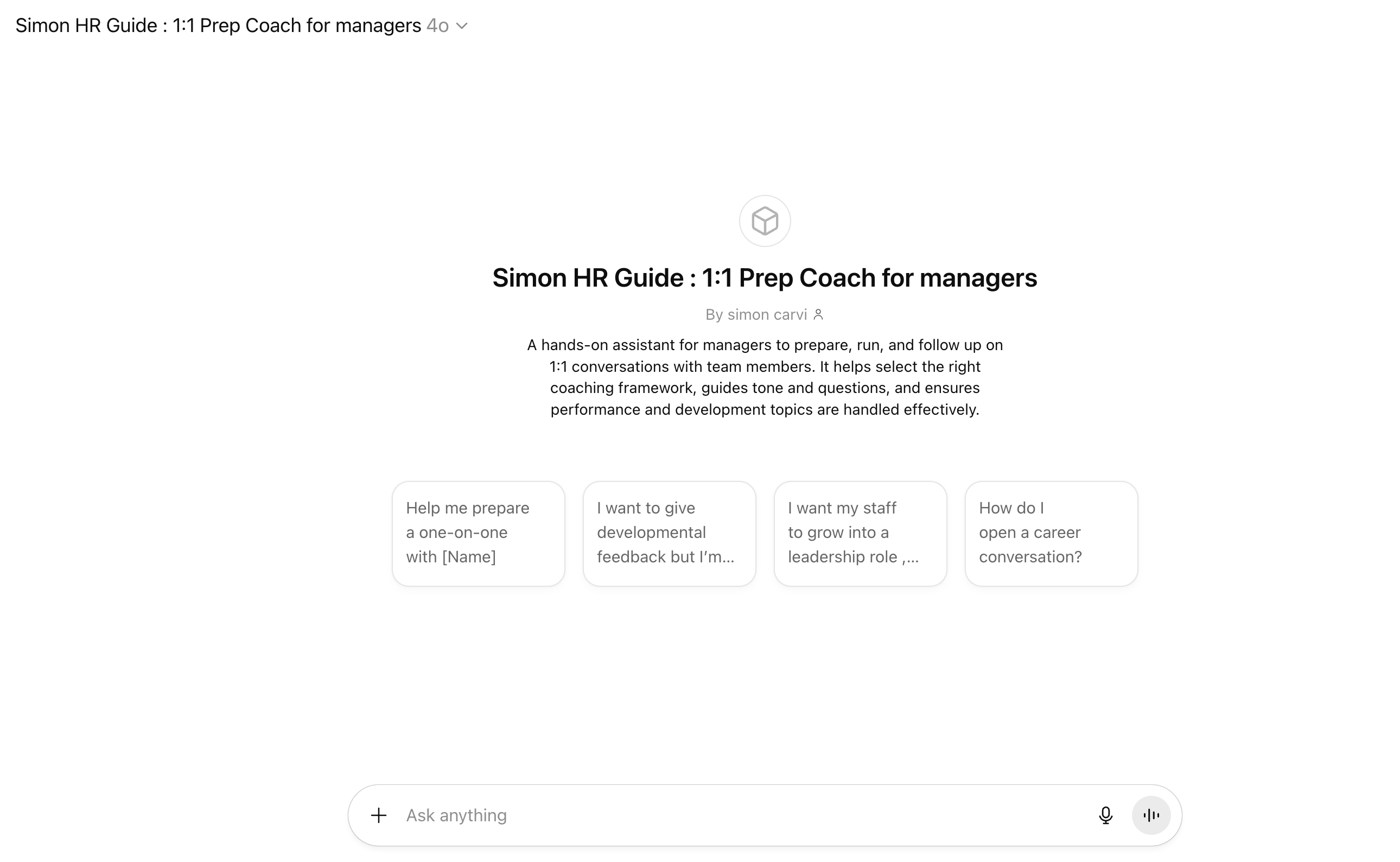
3️⃣ Simon HR Guide: 1:1 Prep Coach for Managers
ChatGPT for one-on-one, manager coaching, feedback
This one’s built for HR business partners and L&D teams.
It helps managers prepare one-on-one conversations with clarity and empathy.
Example prompts:
“Help me prepare one-on-one with [Name].”
“I want to give developmental feedback but I’m not sure how to approach it gently.”
It then provides:
Conversation structure (open, explore, agree, close)
Sample sentences
What to say and what not to say
It’s not a script; it’s a guide.
Use it when:
Managers avoid feedback because they “don’t want to upset people.”
You need to model better coaching behavior.
👉 Here is the link to the GPT for 1-1 preparation 👈
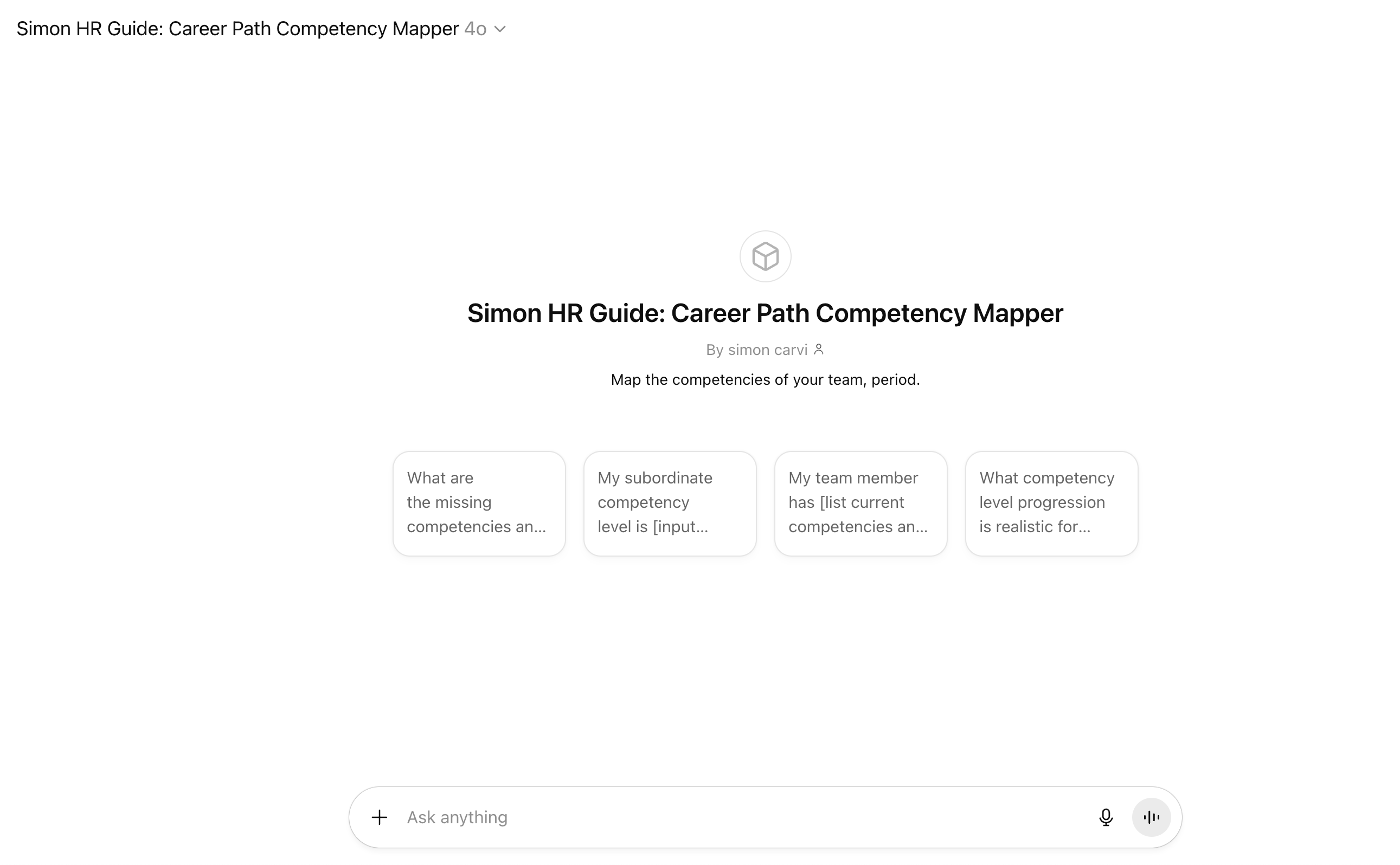
4️⃣ Simon HR Guide: Competency Gap Analyzer
ChatGPT for competencies, career pathing, skill gaps
This GPT compares the competencies of a current role vs. a future one.
It helps HR identify what’s missing and how to close the gap.
Example prompts:
“What are the missing competencies and levels from Sales Executive to Sales Manager?”
“My subordinate’s competency level is [input]. What is the gap?”
Output:
Visual list of technical vs behavioral gaps.
Recommended learning actions (on-the-job, mentoring, course).
IDP suggestions directly linked to those gaps.
Use it when:
You’re planning succession or promotions.
You need data-backed learning recommendations.
You want to stop guessing who’s “ready for next level.”
👉 Here is the link to the GPT for competency gap mapping 👈
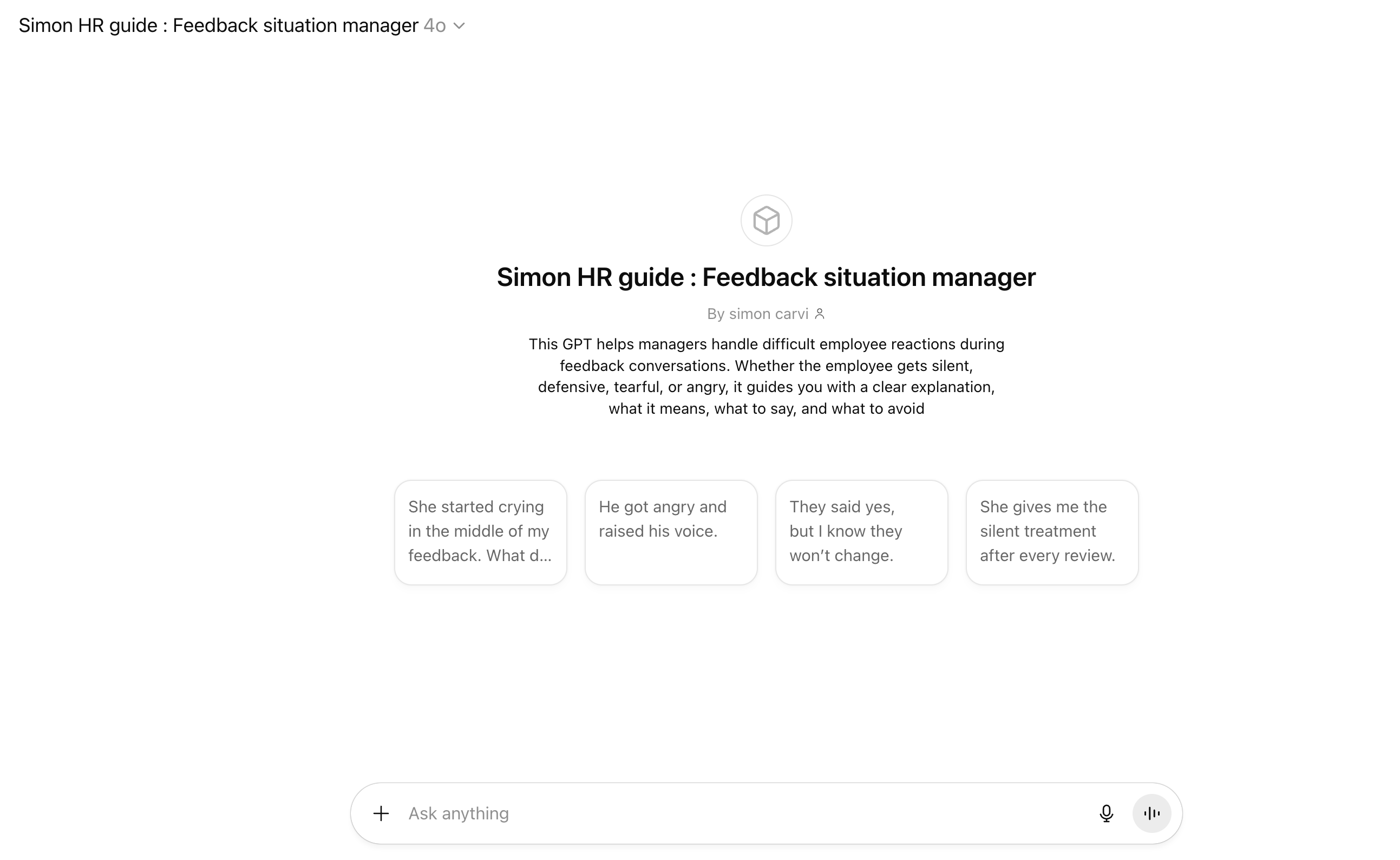
5️⃣ Simon HR Guide: Feedback Situation Manager
ChatGPT for feedback conversations, employee reactions, manager communication
This GPT trains managers to handle tough emotional responses during feedback conversations.
Example prompts:
“She started crying in the middle of my feedback. What do I do?”
“He got angry and raised his voice.”
“They said yes, but I know they won’t change.”
“She gives me the silent treatment after every review.”
It then tells you:
What this reaction means.
What to say (exact phrases).
What to avoid saying.
How to follow up.
👉 Here is the link to the GPT to manage feedback situations 👈
It’s empathy + structure. Basically what a coach could advise on tricky workplace situations.
🧩 How to build a Custom GPT for HR
You don’t need to be a tech genius.
If you can design a training program, you can design a Custom GPT.
Here’s how to do it (without overcomplicating it):
Pick a clear use case.
Example: “Help me turn manager feedback into structured learning plans.”Define who it’s for.
HR? Managers? Employees?
The GPT must know its audience.Write clear instructions.
What tone should it use?What rules should it follow?
What tasks should it never do?
Add your knowledge base.
Upload internal frameworks, policies, or templates.
That’s how your GPT becomes “yours,” not generic.Test and iterate.
Ask real HR questions. Adjust until the outputs sound like your HR team.
Best ChatGPT prompts for HR professionals
Here’s a list of real prompts you can copy, paste, and adapt today.
Recruitment
“Write a job description for a [role] focused on [key responsibilities], tone: practical, not corporate.”
“List 5 structured interview questions to assess teamwork for a [role].”
Learning & Development
“Turn this post-training feedback into 3 actionable development goals.”
“Draft a follow-up message to a manager whose employee completed leadership training.”
Performance Management
“Summarize this feedback into a balanced review: strengths, areas for improvement, next steps.”
“Create a SMART KPI for ‘increase operational efficiency’ at department level.”
Manager Coaching
“Prepare me for a 1:1 with a defensive employee: how to stay calm and get results.”
Employee Relations
“Draft an email to an employee reminding them about punctuality issues in {this context} professional but firm.”
When you combine these prompts with context (who, what, when, tone), ChatGPT becomes a useful tool to get out of the way of some operational tasks..
Why HR must lead AI adoption
If you wait for IT to tell you how to use AI, you’ll still be waiting next year.
HR should take ownership of how AI is used in people processes: from ethics and transparency to skill development.
That said, let’s stay realistic. These prompts will not “change your life” or transform your organization overnight.
But they will make your work more practical, help you save time on repetitive tasks, and improve how you deliver value in everyday HR situations.
If your use cases are clear, ChatGPT can accelerate your productivity immediately.
And for those interested in the bigger picture how AI adoption can reshape entire HR systems I’ll cover that in an upcoming article.