
How to build a competency framework
Most competency frameworks end up forgotten in an Excel file. Here's how to build one that managers use, employees understand and HR can actually maintain.

There used to be a time when building a competency framework required a full HR team, months of workshops and expensive consultants.
Today AI has changed that completely.
Generating a first version of a competency framework is no longer the difficult part. The difficult part is making sure it 1) actually reflects how your business operates and 2) how to deploy and maintain the framework over time.
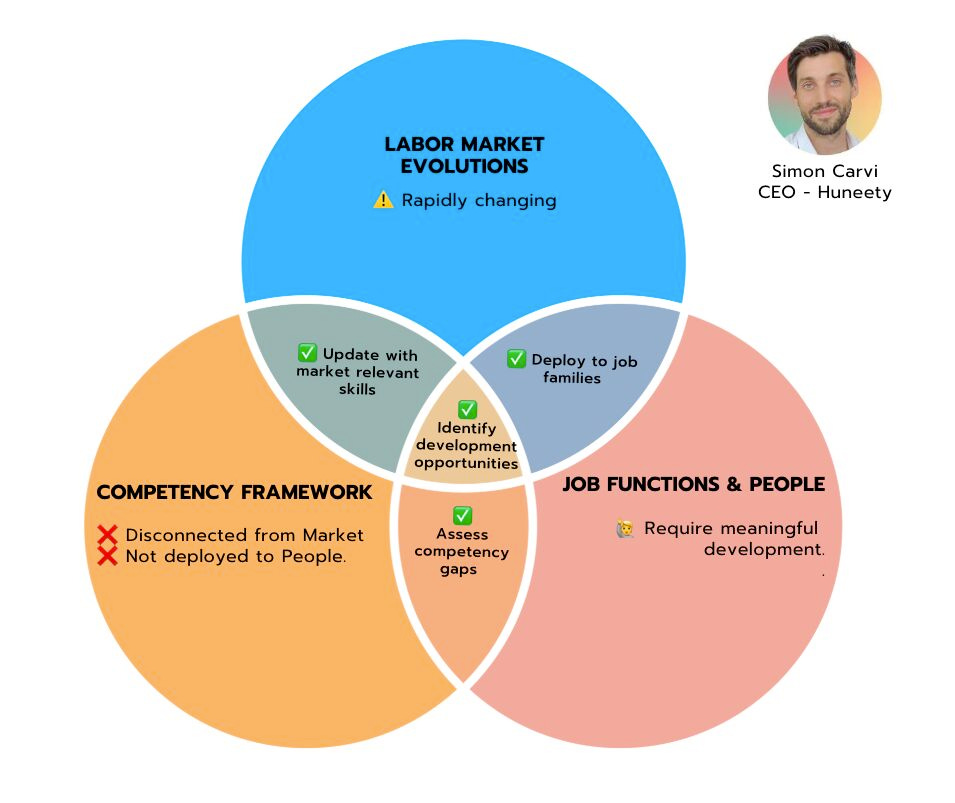
At the macro level, a competency framework helps to make the bridge with labor market evolutions and your people in the organization (see picture below).
But first things first : 🛑 Do not build a competency framework IF
You are the only HR in the company and you have no tools to support : the effort to maintain and deploy it is overkill.
Your company’s maturity does not allow it. If you are at a phase where your company only believes in KPIs, rolling out a full competency framework right away is not the first right move. Instead, start with core competencies and build a framework step by step.
If you are a company with a minimum of resources and there is someone in charge of talent development or learning and development this article might be useful.
Building the framework is the easy part.
Maintaining it is where most companies fail.
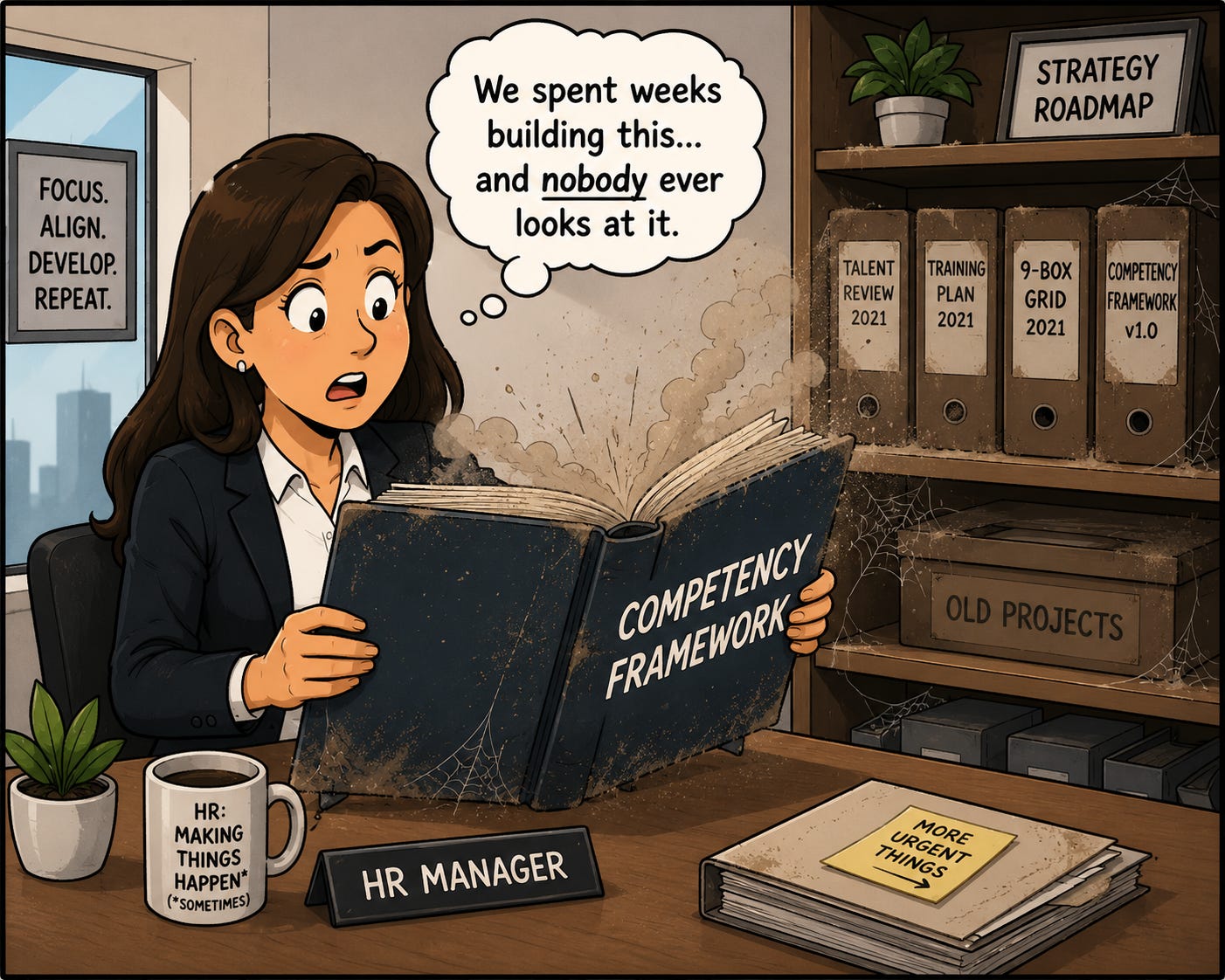
Most competency libraries are delivered as Excel files or PowerPoint presentations. They look comprehensive, but they are painful to maintain and almost never connect with the rest of your HR processes. They simply become another document that HR updates once a year while managers never look at it again.
🚪 There are 3 entry doors to build a competency framework, choose one or several depending on your focus:
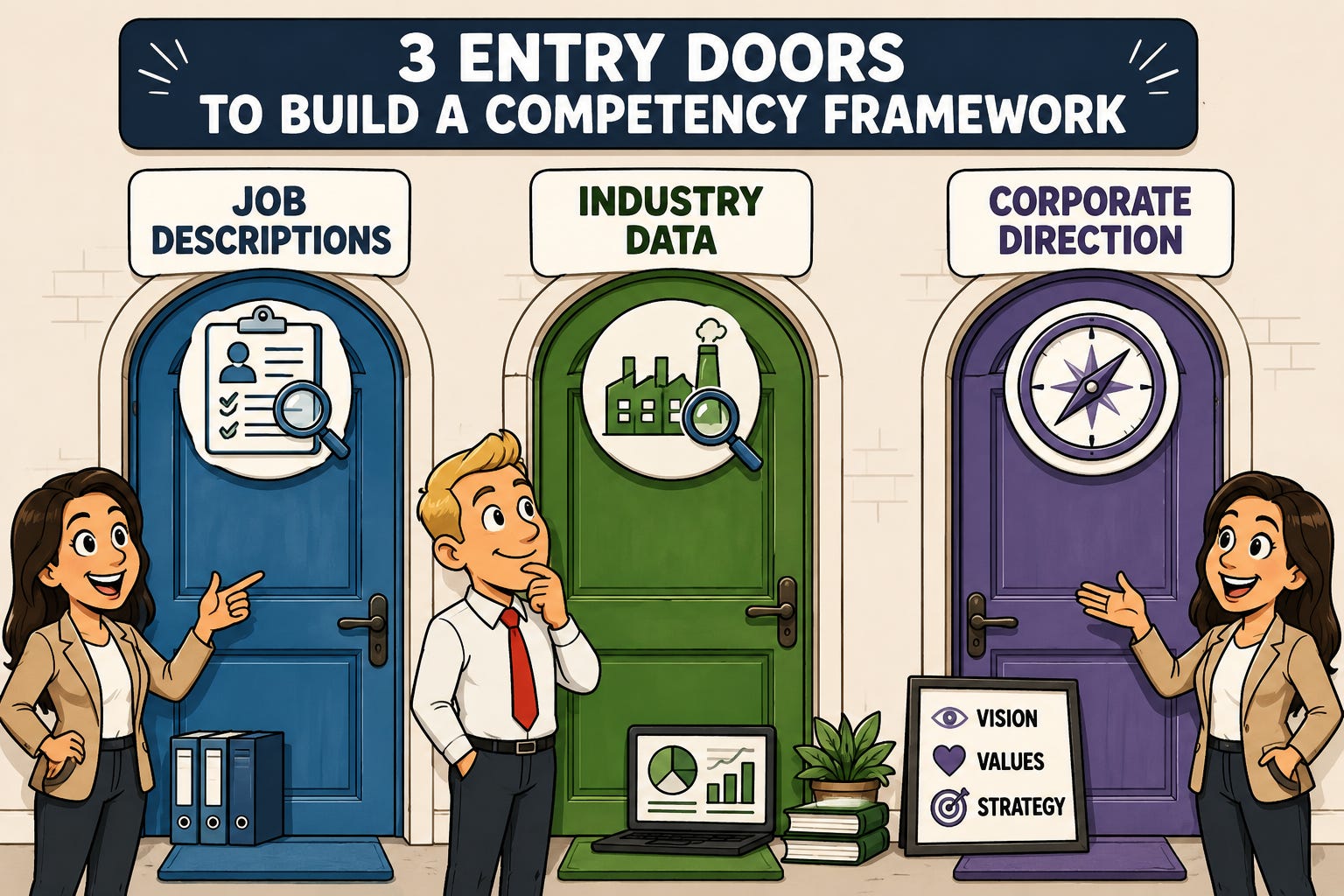
From job descriptions : Map competencies from your JDs. This is good as long as you take the opportunity to harmonize your job descriptions at group level. Otherwise a production manager in site A will end up with completely different competencies with a production manager in site B.
From industry data : Identify industry competencies with either ready made frameworks or with AI. Good for technical competencies and can provide a head start to build the framework.
From your corporate direction : Leadership competencies, core competencies is the easiest way to start.
To build a complete framework you need a mix of the 3 above, but I recommend to start with path 3. These are easier to agree upon and to secure buy in because top management is involved.
Start with definitions
The first mistake I see is surprisingly simple. Companies define competencies using broad statements such as Customer Service, Passion for Excellence or Lead by Example.
The problem isn’t the competency itself. The problem is that everyone interprets it differently.
Ask five managers what Lead by Example means and you’ll probably get five different answers. That makes the competency almost impossible to assess consistently.
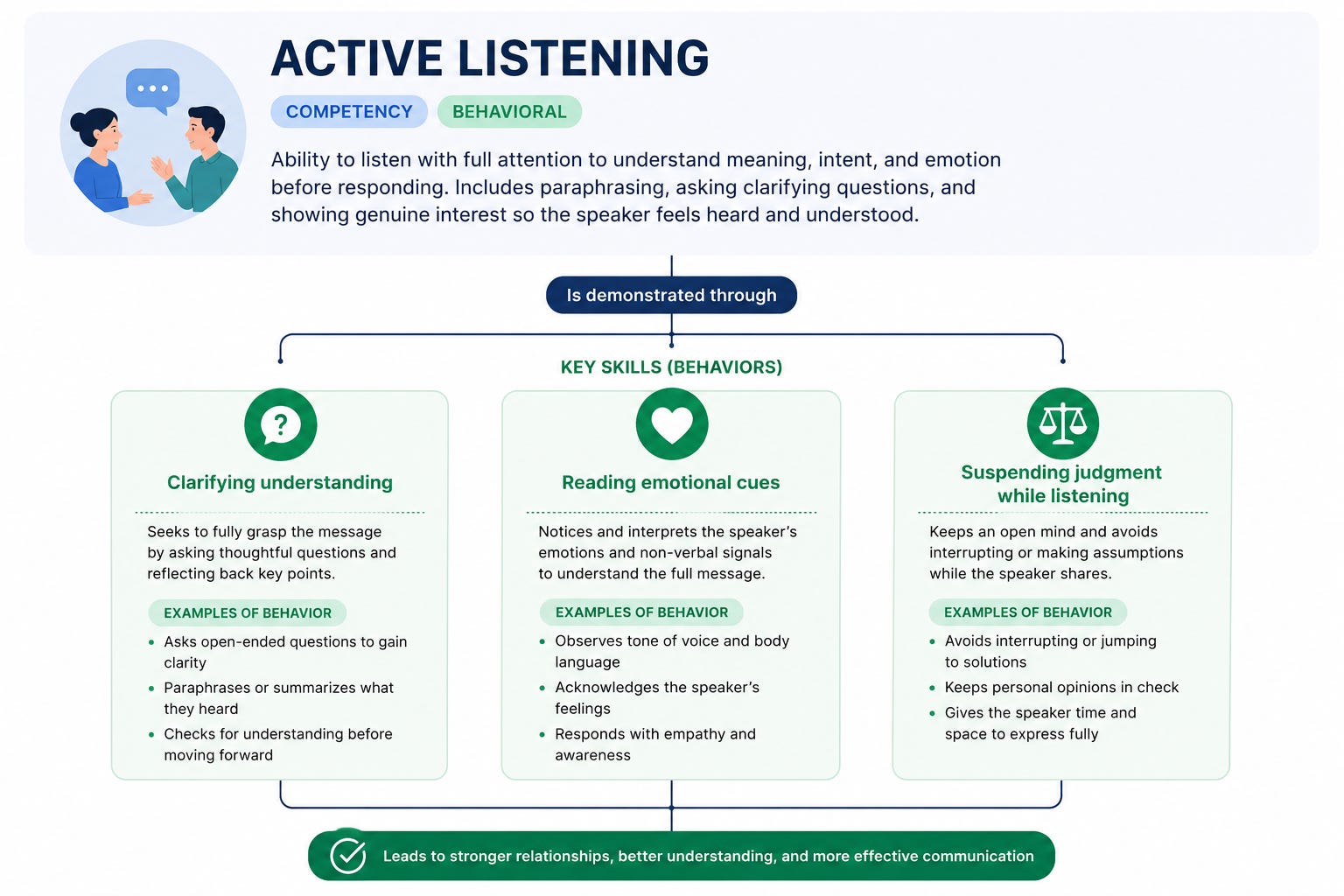
Instead, every competency should be translated into observable behaviours.
For example, don’t “just” use Lead by Example.
Instead of writing Lead by Example, describe what does it mean with practical behaviours such as:
Meets commitments and deadlines.
Takes ownership of mistakes before blaming others.
Follows the same standards expected from the team.
Demonstrates company values during difficult situations.
The competency should be broken down with behaviors, so that managers know what to observe, employees know what is expected and HR has something that can actually be assessed. Here is a visual example for Active Listening :
And that’s the whole point of having a competency framework.
The competency framework should become the foundation of your HR ecosystem. It should help you write job descriptions, assess performance, build development plans, support recruitment, identify successors and define career paths.
As your business evolves, your framework should evolve with it.
Link competencies to skills
To design your competency framework you can :
Leverage on a competency + a clear definition : your definition describes clearly the behaviors required to support the competency at work.
Competencies + related skills : you clearly isolate skills into sub items reporting to the competency group (Recommended)
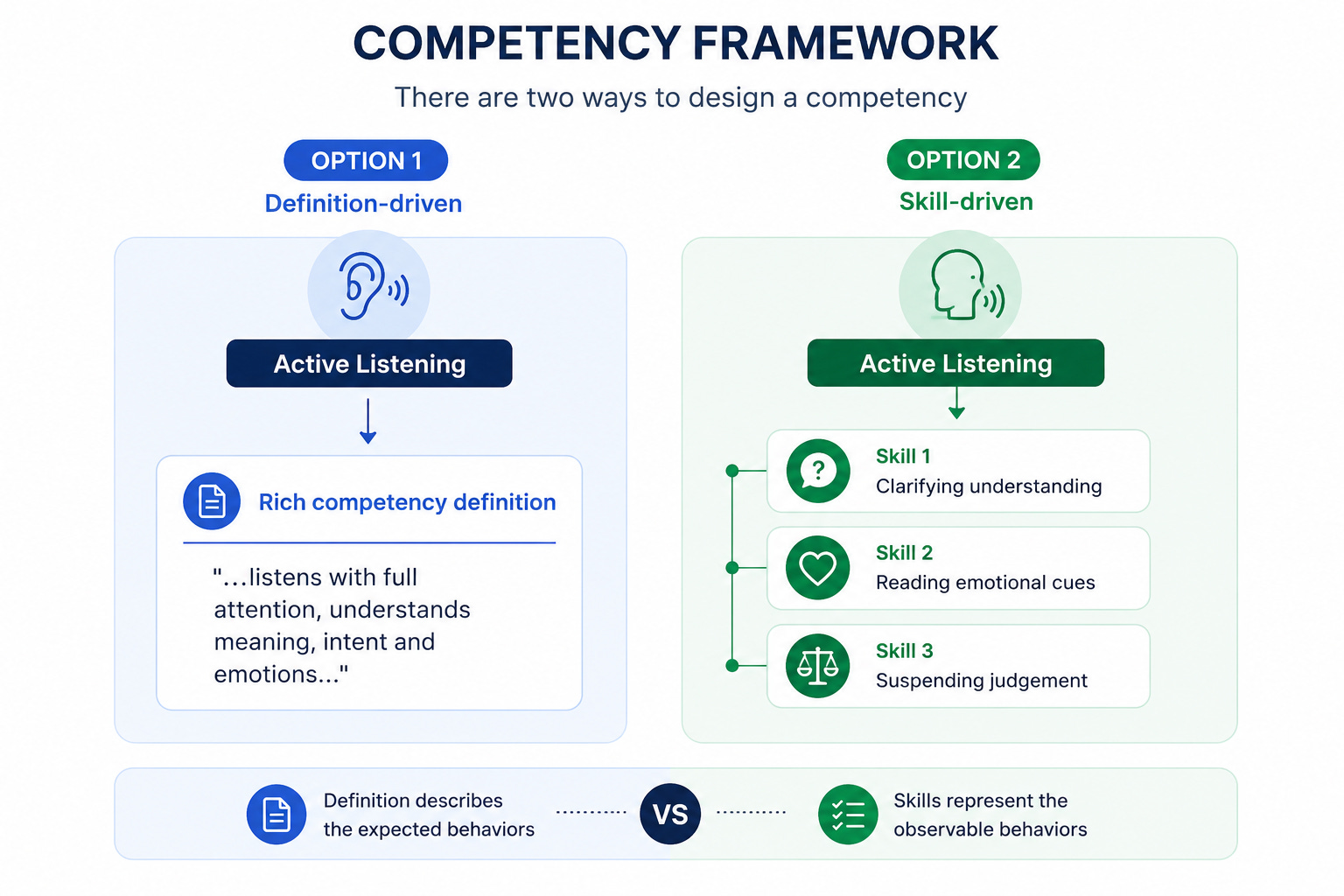
I strongly recommend to opt for option 2.
When you assess each skill individually, you can then consolidate the results into an overall competency score.
Why does this matter?
Because your development plans become much more precise.
Imagine an employee receives a low score in Project Management. That tells you little. But if you know the employee struggles with planning while stakeholder communication is already strong, you immediately know what should go into the development plan.
The more precisely you identify the gap, the easier it becomes to close it, whether the objective is to improve performance in the current role or prepare someone for the next one.
What you want is to assess skills and consolidate scores at the competency level OR assess a competency that presents a very clear definition. Opting for a competency group is generally OK only if definitions are clearly defined and understood across employees (which is rarely the case, my experience).
How to design your competency framework
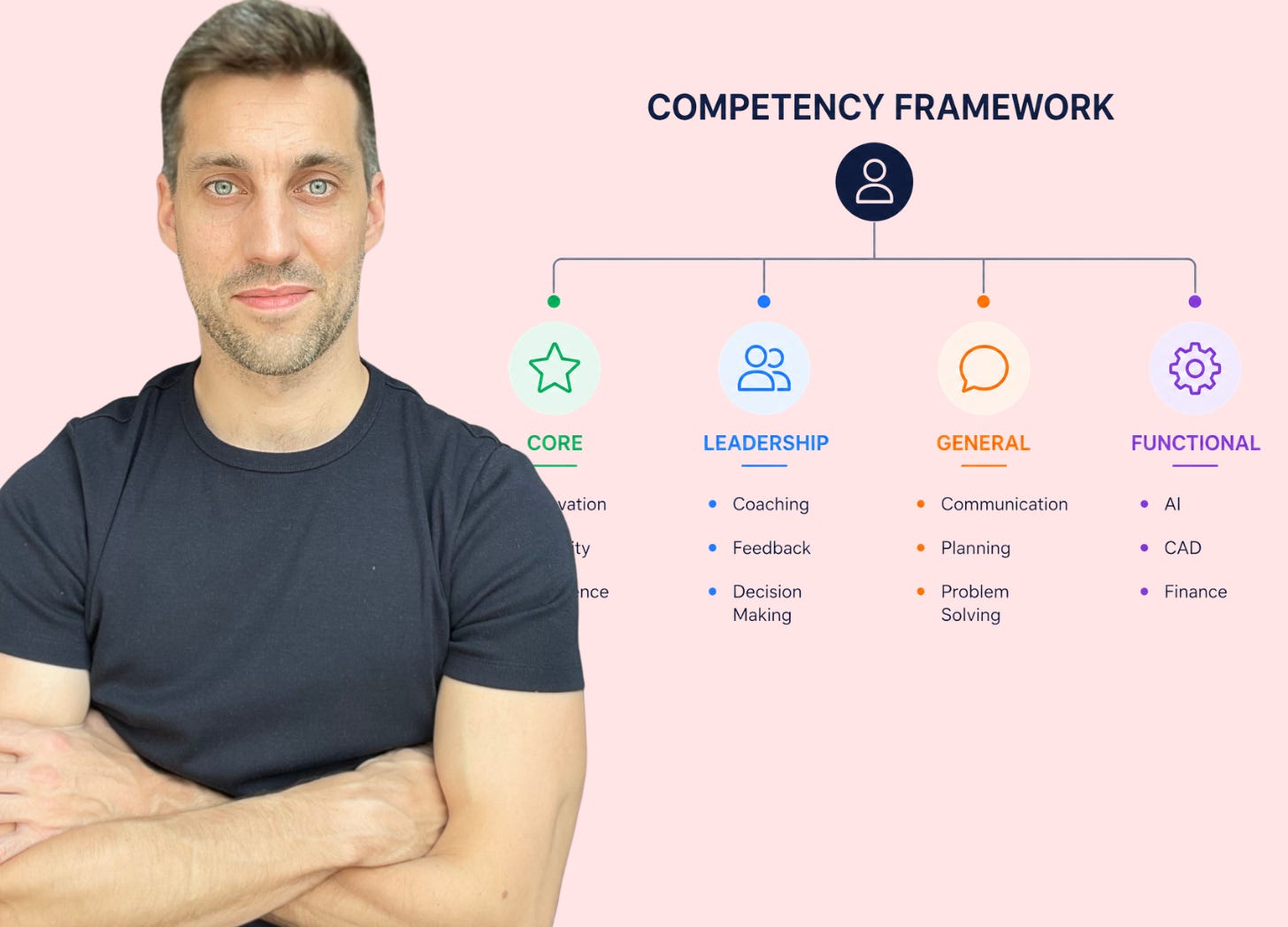
The second question is how you structure your framework. There are several categories, or “roots” that structure a competency framework. Imagine a tree with structured competencies and skills. My recommendation is to organise it around four groups:
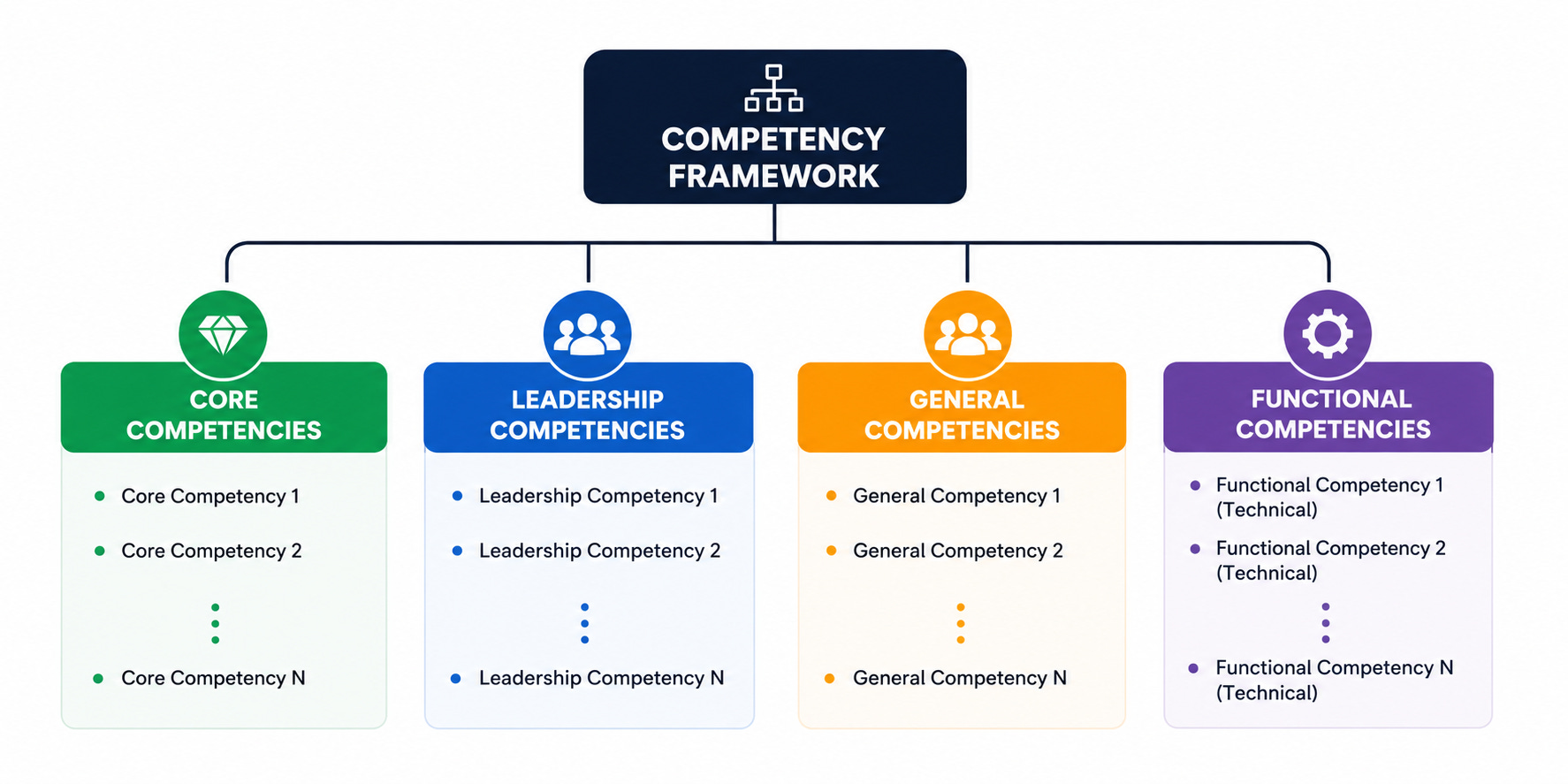
Core competencies : These competencies define your company culture and competitive advantage. They come from top management and apply to everyone in the organisation, no exceptions. For example, one of Apple’s core competencies has always been its obsession with design. That principle influences every employee, not just the design team.
Leadership competencies : These define what good leadership looks like in your organisation. Don’t let every manager invent their own version of leadership. HR should facilitate the discussion and make sure the expectations remain consistent across the company. Decision making, coaching or accountability are common examples.
General competencies : These are behavioural competencies that apply across multiple jobs. Communication, planning, influencing or problem solving can be relevant whether someone works in Finance, IT, Operations or Customer Service. I recommend building a central competency library that managers can reuse across the organisation instead of reinventing the same competencies every time a new job is created.
Functional competencies : Functional competencies are the technical capabilities required to perform a specific role. Using AI, preparing financial forecasts or creating mechanical drawings are all functional competencies. The easiest place to identify them is your job descriptions. Unlike general competencies, these are highly specific to your industry and your business. This is why your managers should play a major role in defining them.
These are general categories, you may create your own as you please.
Attach proficiency scales (Using dreyfus)
A competency without a rating scale cannot really be assessed.
Every competency should therefore include a proficiency scale.
Personally, I usually recommend either the Dreyfus model (Novice to Expert) or a behaviourally anchored scale from 0 to 5.
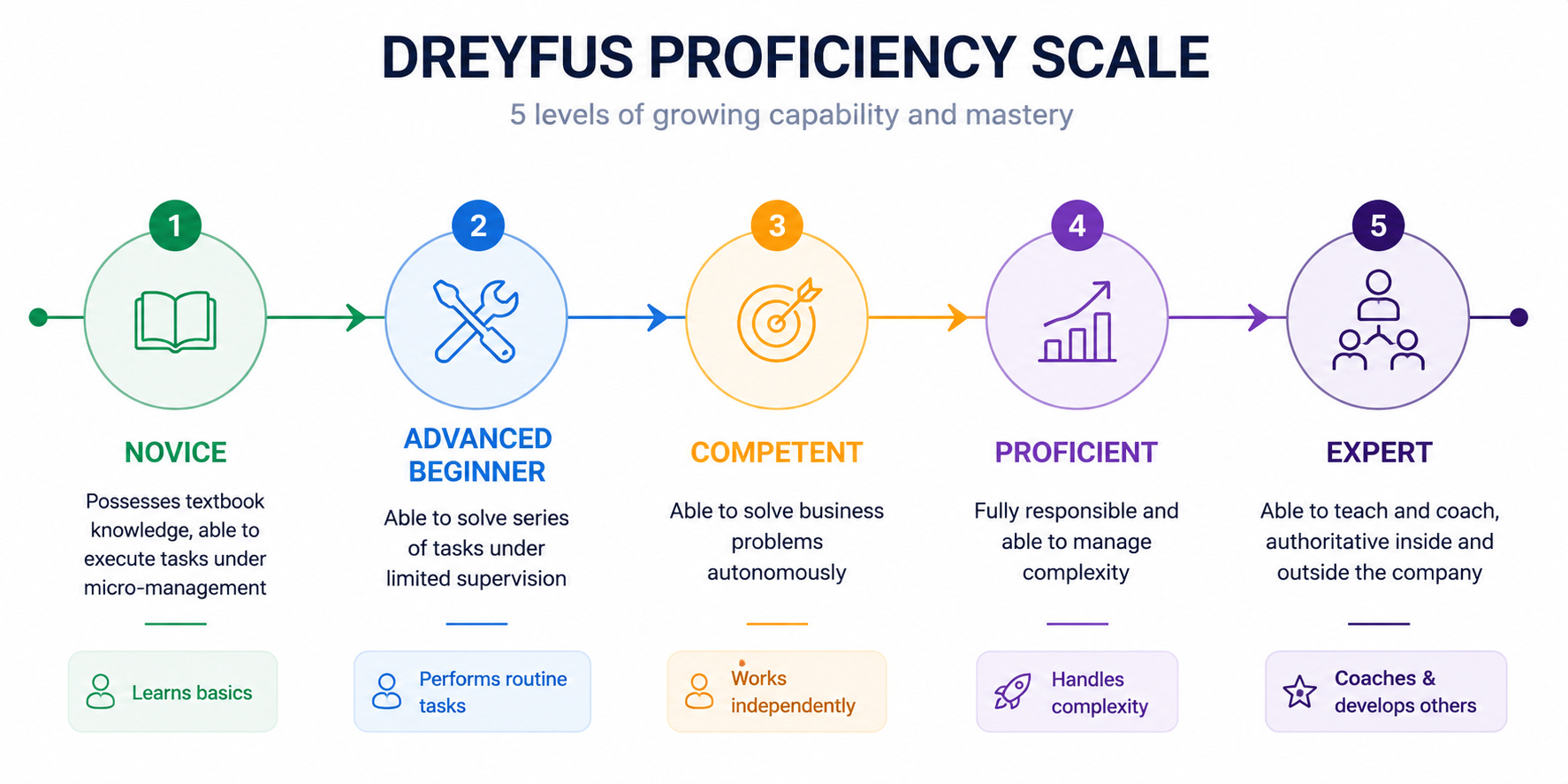
I generally prefer the Dreyfus model because it measures proficiency, and proficiency is exactly what you are trying to evaluate when assessing competencies.
The important point is to distinguish competencies from performance. My thinking is this:
KPIs should be measured using performance ratings because they evaluate business results. Those results usually influence bonuses.
Competencies should be measured using proficiency ratings because they evaluate capabilities. They should influence development plans, salary progression and career growth.
Mixing the two often creates confusion : Results and capabilities are not the same thing.
Mistakes to avoid
You built your competency framework. Everyone attended the workshops. Managers validated the competencies. And then... nothing happens. The framework sits in an Excel file. HR updates it once a year. Managers never look at it again.
Unfortunately, this is exactly what happens in many organisations.
The problem is that the competency framework lives in isolation. It isn’t connected to recruitment, performance management, learning and development or succession planning. Instead of becoming the common language across your HR processes, it becomes another HR document that nobody uses.
Another mistake I see regularly is trying to assess too many competencies. I’ve seen employees evaluated against twenty or even thirty competencies. Let’s be realistic. Nobody can actively develop that many areas at the same time, and managers certainly won’t remember all of them during performance reviews.
The objective isn’t to document everything an employee can do. It is to identify the capabilities that matter most for success in the role. The fewer competencies you assess, the more likely managers are to use the framework consistently.
As a rule of thumb, I recommend putting some limits in place.
Directors: Maximum 16 competencies
Managers: Maximum 12 competencies
Supervisors: Maximum 8 competencies
Individual contributors: Maximum 6 competencies
The same principle applies to your company values. Don’t create ten core competencies because someone in the executive committee wanted to add another one. Keep it simple. Three well-defined core competencies, each supported by three to five observable behaviour, are more than enough to create alignment across the organisation.
When it comes to deployment, don’t build your framework in isolation either.
Your executive team should define the company’s core values and leadership expectations because they reflect the strategy of the business. Your managers should define the functional competencies because they are the people who actually know the jobs. HR’s role is to make sure everything stays consistent across the organisation and that everyone speaks the same language.
Excel is your enemy
Excel works when you have ten jobs. It starts falling apart when you have fifty.
Very quickly you end up with a massive spreadsheet that becomes painful to maintain. Collaboration with managers becomes difficult, updates are manual, and if you’re lucky someone remembers to update the framework once a year.
The biggest problem isn’t even Excel itself. The biggest problem is that your competency framework becomes disconnected from everything else.So instead of becoming the backbone of your HR ecosystem, it becomes another standalone document that HR has to maintain manually.
Competency frameworks are already difficult enough to maintain. Every time someone modifies a competency, you also need to update every job profile, every career path and every assessment that uses it. Doing that manually quickly becomes impossible.
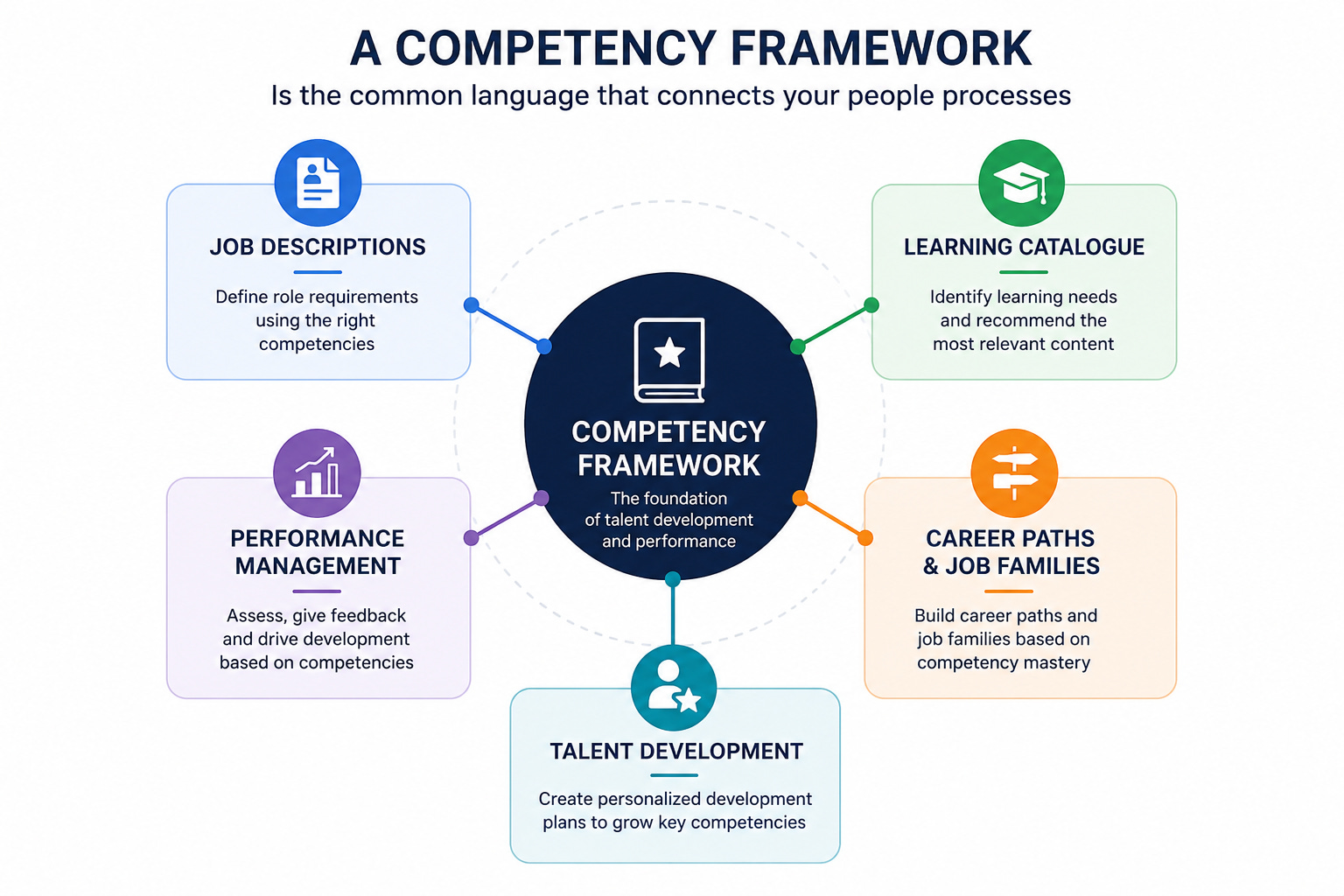
What matters is choosing a system that helps you do more than simply store competencies. You may use your HRIS or use a tool like Huneety learning to deploy the competency framework.
You should be able to generate job descriptions, deploy competencies across jobs and career paths, assess employees, visualize skill gaps and automatically generate development plans.
Building the framework is only the beginning. Maintaining it and connecting it to the rest of your HR processes is where the real value is created.
Assess competencies to close gaps
Your competency framework should also become the foundation of your learning strategy.
The process then becomes straightforward : Build the framework → Assess competencies → Identify gaps → Build IDPs ( Recommend learning) → Monitor / Reassess.
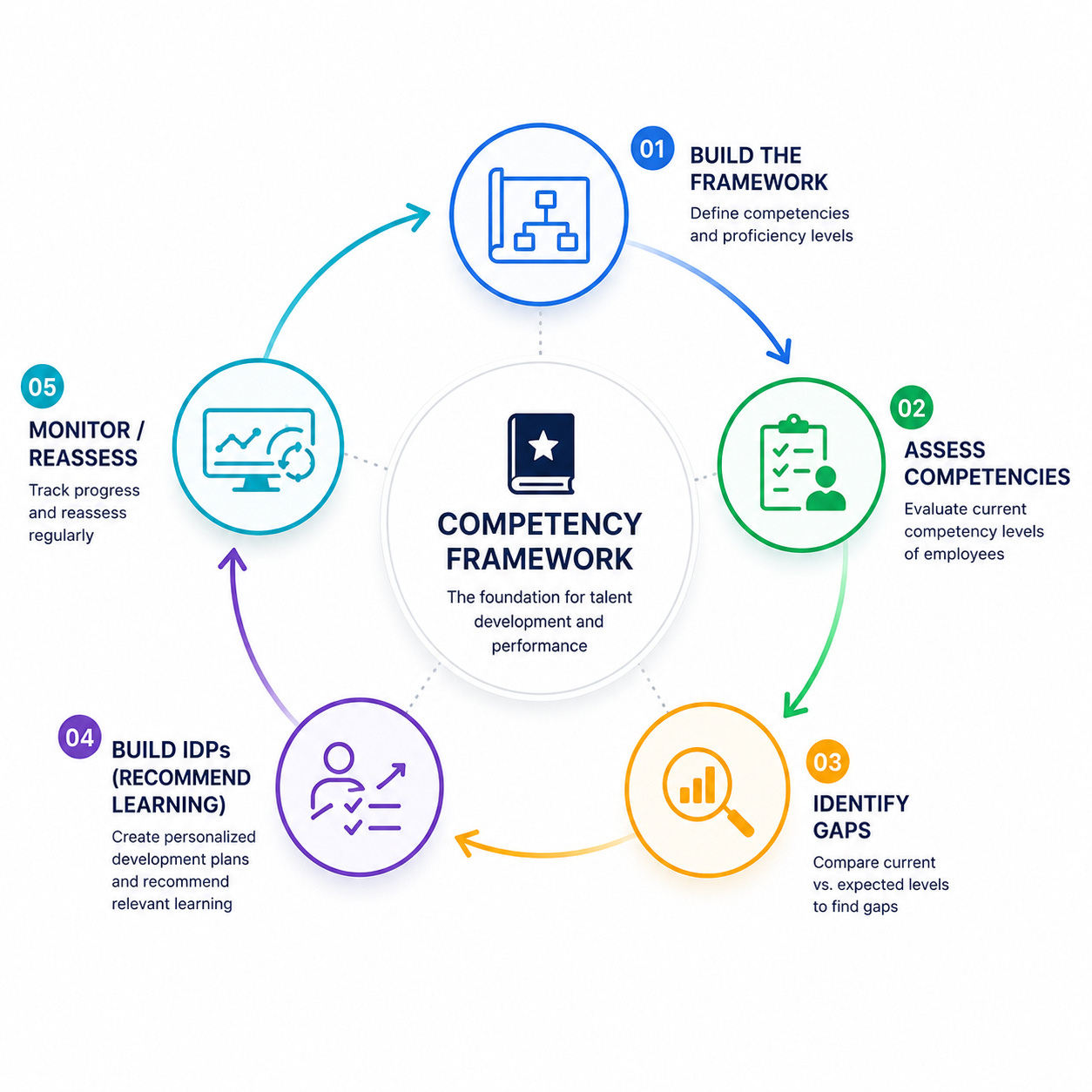
To my view your company’s training survey = the competency gaps of the assessments.
Instead of sending employees to training because there is budget available, you create a continuous development cycle driven by actual business needs.
That also changes the conversation with your CEO. Instead of answering the question, “What did we get from our training budget?”, you can answer with evidence.
“We identified a project management gap across our engineering teams. We assigned targeted learning, reassessed the competency 1 year later and proficiency increased from 2.8 to 3.9.”
That’s the return on your training investment. Training should never exist on its own.
It should improve competencies and competencies should improve business performance.
Monitor deployment with the performance management process
The easiest thing you can do is to embed the review of the competencies together with the performance management cycle, that’s it.
Competencies should be reviewed through regular one-to-ones, formal performance reviews, and year-end evaluations. This ensures managers continuously assess competencies, identify development needs, and track progress over time.
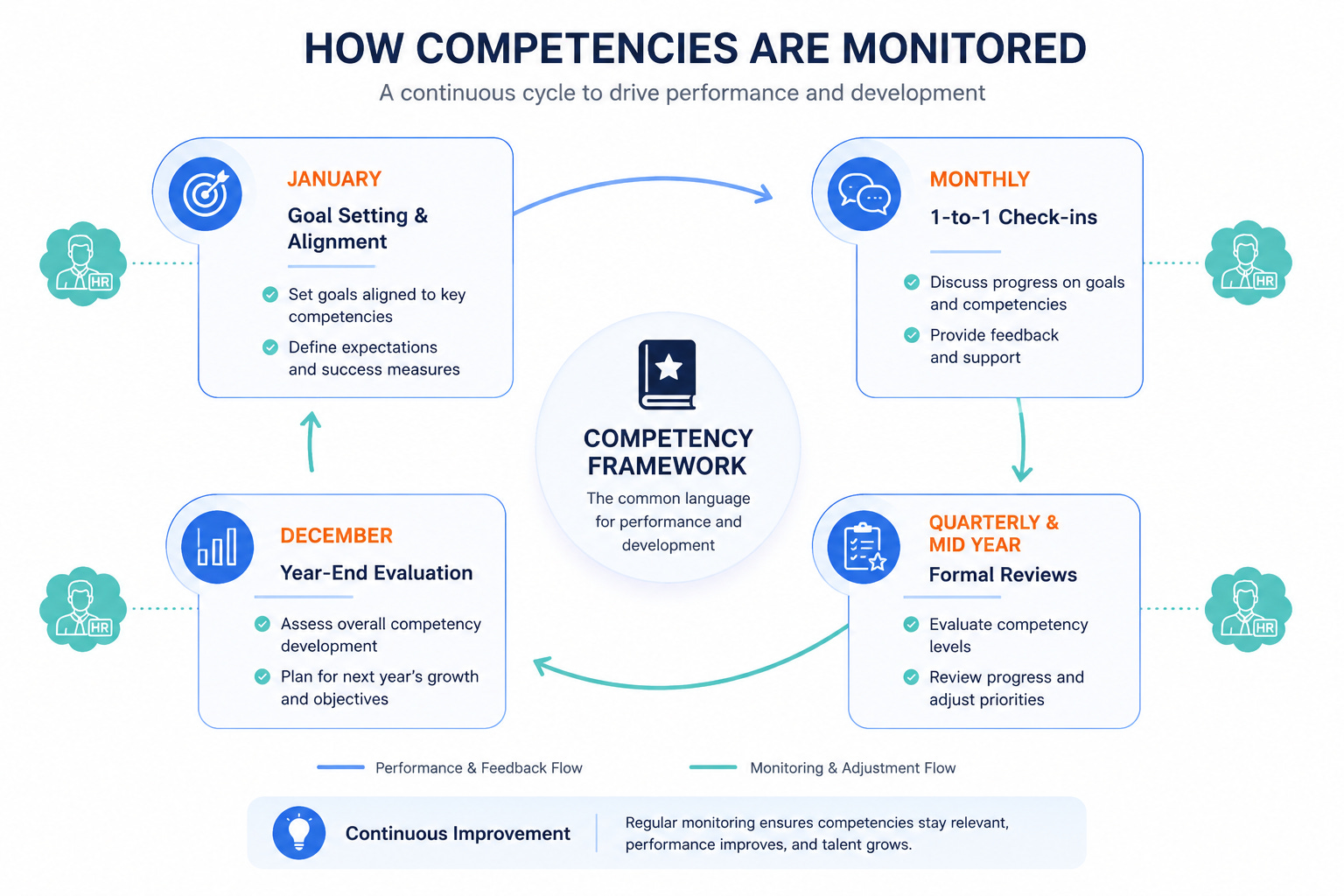
This means that before you start building a competency framework, ensure you have a performance management system in place first 😊.
Last stop : How how to build an IDP to bridge competency gaps
Read my previous articles on IDPs :
I’m organizing a free HR webinar for HR professionals on how to build effective Individual Development Plans (IDPs). If you’d like to learn how to create development plans that close competency gaps, I’d be delighted to have you join.
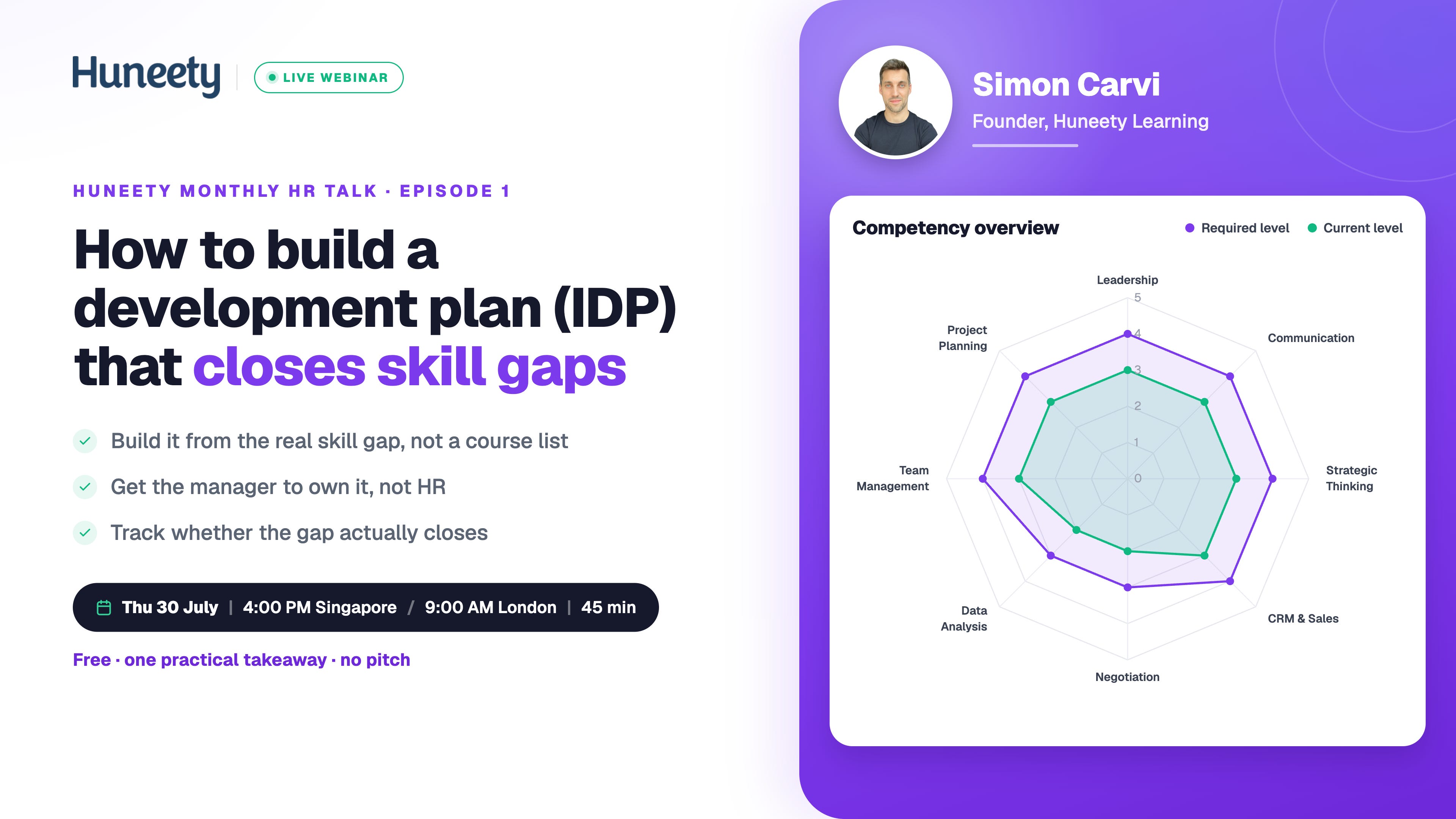
30st of July - ⏱️ 4pm Singapore / 10am Paris / 9am London