
Training content is free now. Development isn't.
And why I provide my management training for free.


Not long ago, content was the expensive part of learning. The learning budget was the training provider.
A good course cost real money. It sat behind a license, inside a platform the company had paid thousands for. Companies bought catalogs, gave employees access, and called it learning.
Learning was something you purchased.
That world to my view is gone, and most L&D budgets have not noticed.
Is that fair to the people who make the content? Probably not. I believe good work deserves to be paid for. But the march is on with AI, and it is pretty much “adapt or die” for the whole L&D function.
Today your people can learn almost anything for free. YouTube, free courses from the best universities on earth, and for the price of a basic ChatGPT subscription employees can ask unlimited questions whenever they get stuck. The material you are still paying a premium for is sitting on the open internet, often better, for anyone who bothers to look.
“We already pay for a platform with thousands of courses,” a Head of L&D told me recently. Although many L&D department view the training catalog as the primary source of expense, I believe the focus should shift to the results it delivers (if it hasn’t already).
🎥And for the record: I still believe it’s worth investing in high-quality, in-person learning experiences that requires facilitation. But simply delivering content is no longer where the value lies. That’s my message to training providers out there.
Owning content is not a strategy anymore
When content was scarce, access was the bottleneck, so buying access made sense. Now content is everywhere and access is nothing. Your competitive advantage is no longer the catalog. It is what happens after someone finishes learning.
So the real question changes. It stops being “What courses should we buy?” and becomes “how do we get this specific person better at the specific thing their job needs.” For HR and L&D professionals that has always been the real objective anyway.
It was simply easier to hide behind a large training catalog and create the illusion that we were solving upskilling.
But here is the paradox
If everyone can reach the same free content, why do a few people get dramatically better while most do not?
It is not the material. Two people watch the same course. free or not. One improves, the other forgets it by Friday. The difference is not what they watched. It is whether they were expected to produce something afterwards, whether they had a chance to practise it, whether someone gave them feedback, and whether they kept improving after the course ended.
A standard course does not know the context. It cannot see the person, the team, or the mess they are managing.
That is the whole shift I keep pushing with HR teams. Buy less content. Design more development. Training content is what you push at people, a module the whole team sits through because it was already paid for. Development is what you build around the person: the gap that actually matters for their role, real work and stretch assignments that force them to close it, while training content provides the knowledge to support the work (not to replace it).
Why I give my training for free.
I have always believed in doing over theory.
I created the Monday Simon initiative for one reason: management practices you can apply on Monday morning.
But before you can apply anything, you need the fundamentals. How do you give constructive feedback? Set clear objectives? Build a development plan? Make a promotion decision? Handle a termination professionally? Those are things every manager needs to know before they can put them into practice.
So I decided to make that knowledge free for everyone. I only charge the people and companies who want me alongside them afterwards to coach, implement, and make sure those practices become part of how managers actually work. If they don’t, that’s perfectly fine.
There is another reason I decided to make this free. I think we have been teaching the wrong things. Over the last few years leadership has become the fashionable topic. Every conference has a keynote on inspiring teams, creating vision, or becoming an authentic leader. Meanwhile, the day-to-day skills that actually make someone a good manager are often treated as an afterthought.
Yet for most managers, that is the job.
There is too much hype about leadership, when what makes companies strong is good managers. Leadership is built on good management, not the other way around.
Would you call someone a leader if they never give their team feedback? If nobody on that team knows what they are measured on? That is the essential of people management, and it is the part nobody puts on a conference stage.
The six modules of my Manager Development program (FREE)
About 5-7 hours with assignments, self-paced, free.
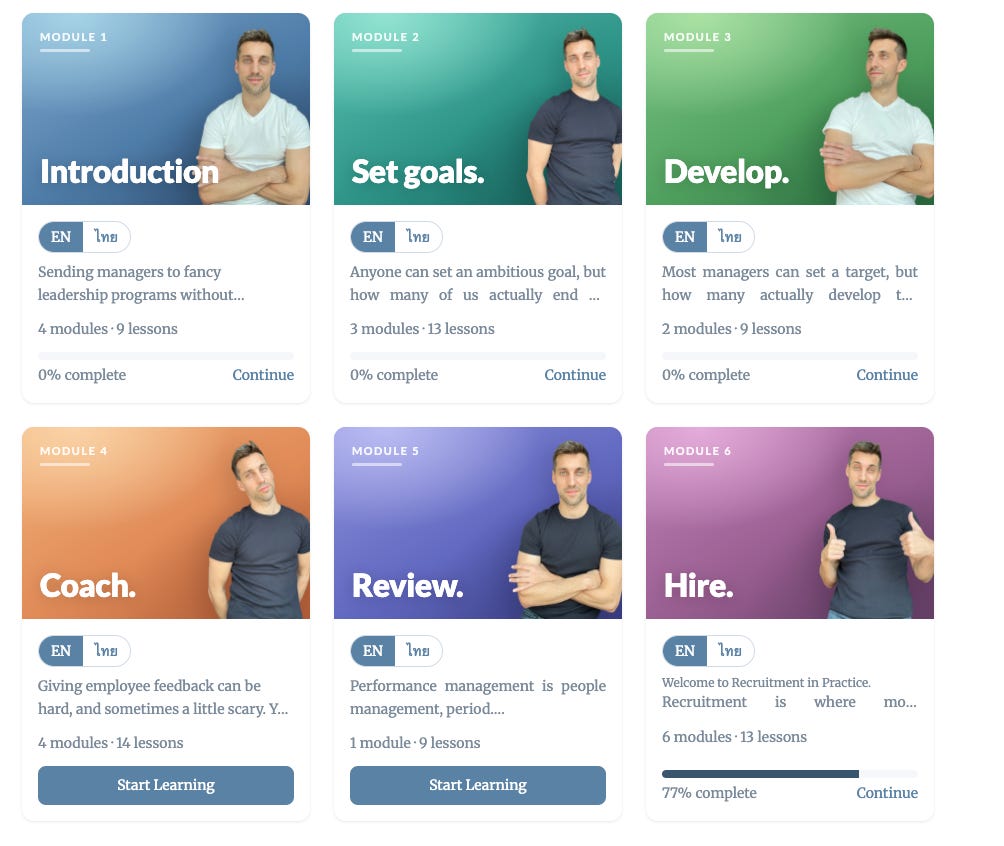
People fundamentals : what managing people actually means.
Goal setting : goals your team can actually deliver (Setting the KPIs and SMART action plans).
Team development : How to create development plans essentially with the 70/20/10 framework.
Feedback and coaching : How to provide feedback to teams.
Performance management : fair calls on who to grow, reward, or let go.
Recruitment : hire on criteria, not gut.
🗣️ This is version one. I keep adding to it based on what managers tell me is missing. If the thing you need is not in there, reply and tell me.
It is free. Not a trial. Free, and staying free. Because charging you for it would make me the thing I just spent this whole article telling you to stop paying for.
What I do charge for
The hard half.
A system to run the managerial rhythm, with competencies and KPIs tracked in the platform, permanent assistance, and my coaching support. That is the paid part, for individuals and for companies that decide it is the right moment to get permanent results. I keep the coaching priced so a manager can actually afford it.
So, what is the catch?
There isn’t one, and there is no catalog either. I am not selling you five thousand courses. I am giving you six that cover what a manager actually has to do on Monday, and keeping the price on the follow through.
If you run HR or L&D: you have thirty or forty managers and no training line in the budget for them this year. Send them the link.
If you are the manager: take it yourself.
