
Why your manager training fails : 4 Reasons Your Program Doesn't Stick (and what to do)
Stop training managers. Implement a system instead.

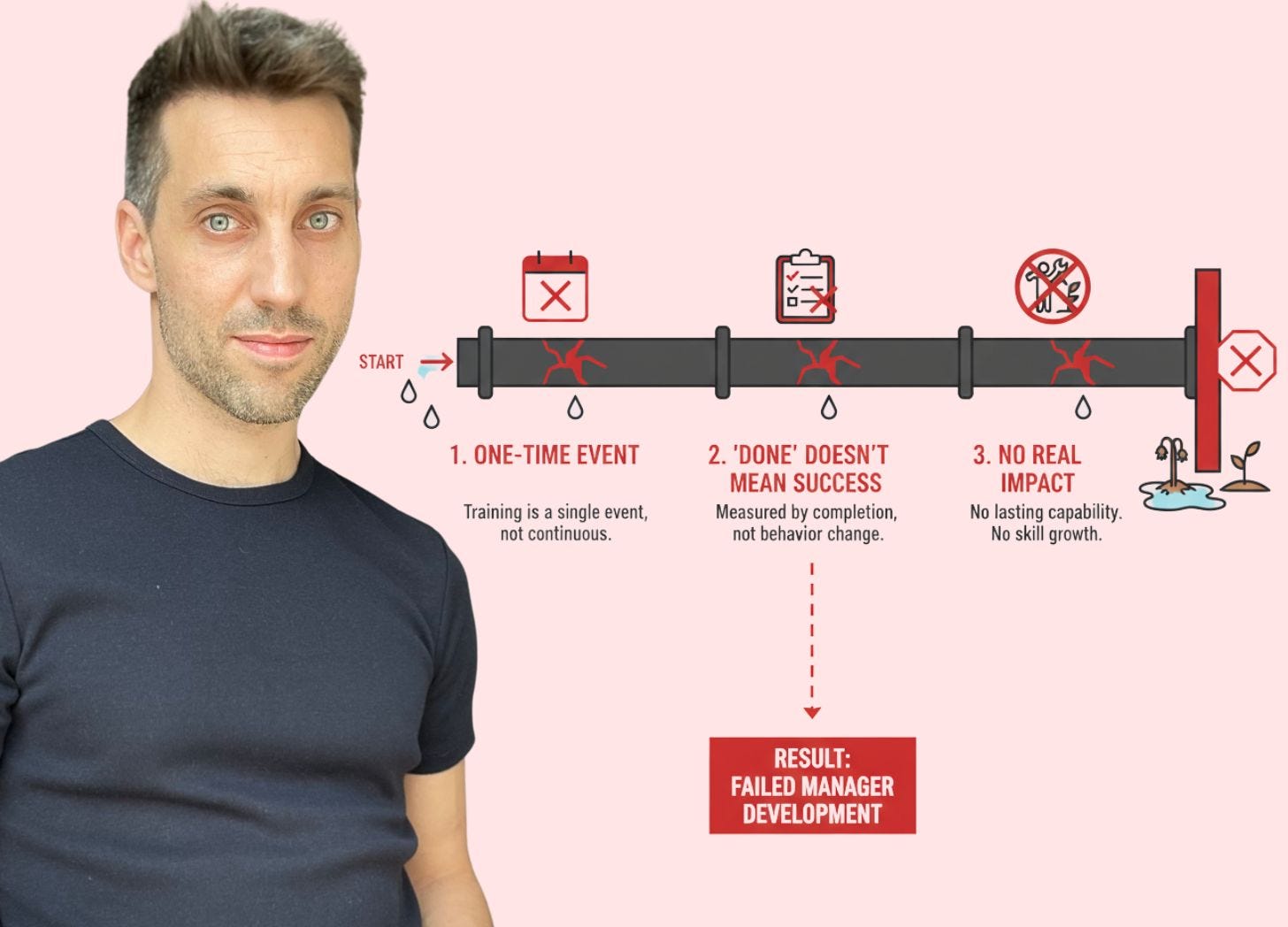
You spent $X,XXX or $XX,XXX on new manager training last quarter.
No matter the amount, it’s probably too much for what you really get in return.
I’m like you. I also scroll on LinkedIn and see company-wide leadership projects where managers give thumbs up in pictures. These same managers walk out of the room energized, notebooks filled with frameworks, and a list of Dos and Don’ts, plus a perfect understanding of their “manager type.”
For these workshops or training programs, it costs a lot of money. The kind of money that provides leadership peace of mind :“With this trainer, we can’t really go wrong.”
But once managers go back to their desks, the excitement fades and the old habits creep back in.
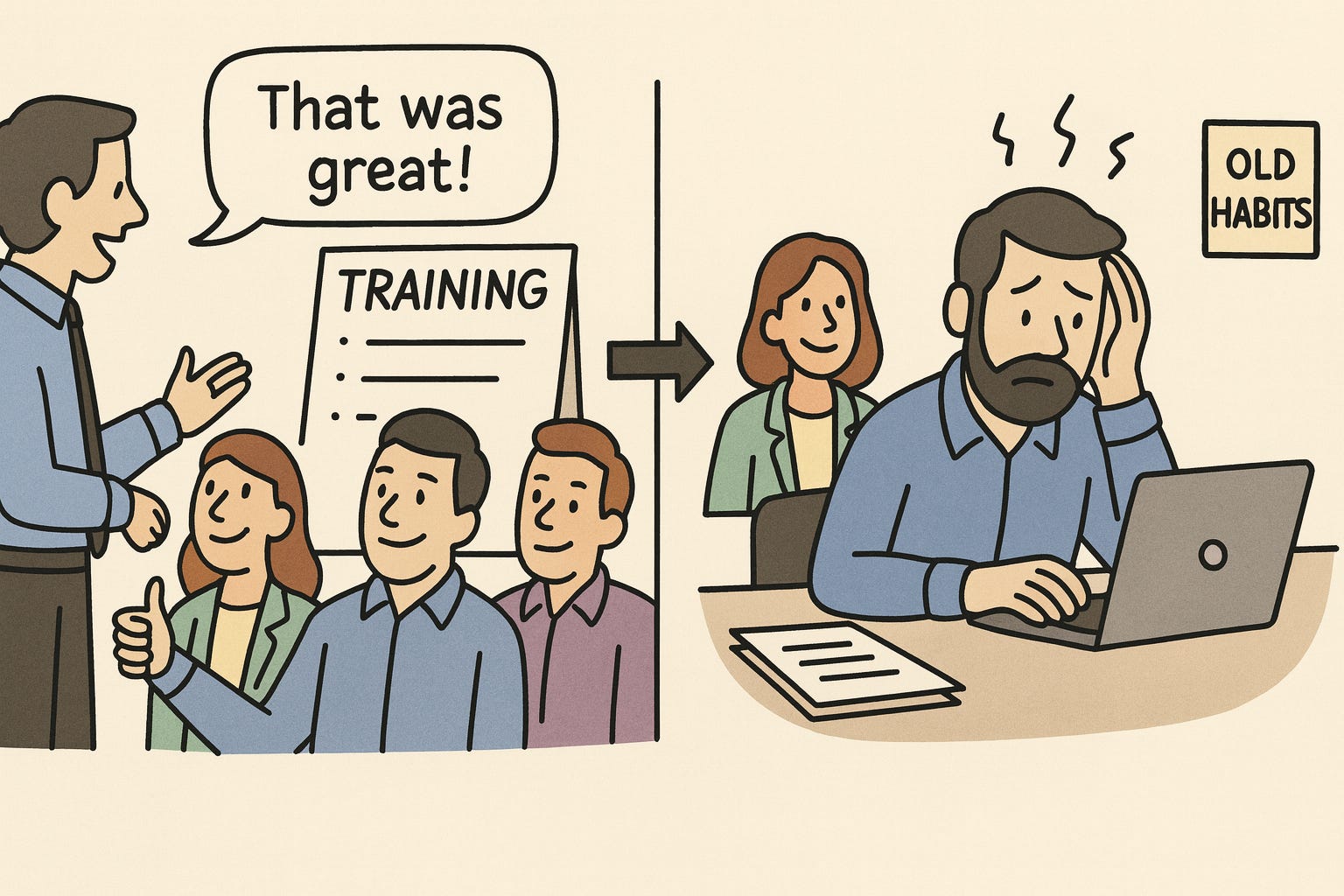
Sound familiar? You’re not alone. Most companies have the same story: great training feedback, glowing post-event surveys… and zero visible behavior change afterward.
Last month, I coached a manager who had attended three leadership seminars, and yet.. he was never taught the basics of giving and receiving feedback.
This isn’t a training problem. It’s a design problem, and it’s costing you more than you think.
Let’s unpack what’s actually happening and why even the most polished programs fall apart by week 3 (or even earlier).
The diagnosis
To simplify it, new-manager training fails for four predictable reasons that I’ll explain in this article.
1. Training happens at the wrong time
Here’s the classic setup: an employee gets promoted to manager, drowns for a few months (or years), and then gets invited to “New Manager Essentials.”
By that point, it’s too late. They’ve already developed coping mechanisms (usually bad ones) by mimicking whatever the top boss has been practicing. They’re just trying to survive.
Let’s be honest: training someone after they’re already drowning is like teaching them to swim after you’ve thrown them in the deep end. Sure, they might learn eventually —or they might just keep flailing.
My point here is that most companies aren’t even aware of whether they are promoting good managers. That uncertainty is costing you.
If you want the lessons to stick, timing is everything. Managers need the fundamentals before they take on the team, not after. A short pre-promotion learning sprint even two or three focused weeks can save months of pain later. I strongly advice to implement a 30 60 90 day plan for new managers, it ensures you mitigate critical mistakes right from the start.
2. It’s one-and-done instead of spaced learning
Most corporate training still follows the same recipe: two intense days, hundreds of slides, and a certificate at the end.
And then… nothing.
My point of view: certificates of completion mean nothing. Sure, a completion badge is always useful, but it won’t ever tell you if managers actually get sh*t done on the job.
Within 24 hours, people forget about 70 percent of what they learned. Within a week, they’re back to their default mode because there’s no structured reinforcement, no follow-up practice, and no accountability to apply the ideas.
You wouldn’t learn to play piano from a weekend workshop and never practice again. Why do we think management works differently?
The best programs are built like fitness plans, not flash courses. You introduce one concept at a time, practice it in real life, review what worked, and build from there. Over a 90-day period, small weekly actions compound into actual behavior change.
3. It focuses on leadership theory, not real-world practice
Let’s face it: managers don’t need another lecture on the definition of SMART goals. They need to write one.
They don’t need to memorize a feedback framework = they need to deliver feedback to an underperforming employee without freezing.
Too often, training rooms become echo chambers of leadership theory.
You can’t learn to have difficult conversations by listening to someone talk about difficult conversations. Skills require reps. It’s like learning surgery from textbooks : you might ace the exam, but would anyone trust you with a scalpel?
The topics themselves “navigate change,” “be inspirational” matter for the top C-suite, not the middle managers working in the trenches.
Real learning happens when managers bring their own situations to the table: real goals, real feedback conversations, real team conflicts. When they practice on their actual work, the line between “training” and “doing” disappears and that’s where development sticks.
4. There’s zero follow-up or accountability
The training ends, certificates are handed out, and everyone goes back to their inboxes. HR celebrates the completion rate : 100 percent! But has no clue whether anyone is doing things differently.
There are no check-ins, no behavior metrics, no coaching follow-up. Within weeks, the glow fades and the old ways return.
Bottom line: what gets measured gets done. What doesn’t get measured gets forgotten by week 3.
You can’t expect change if you never check whether it happened.
The cost
“So what? Everyone forgets some of the training.”
True. But the price tag is higher than you think.
Here’s how it plays out:
Week 1: The new manager tries to apply what they learned, hits a real-world wall because it’s not as actionable as they thought, and reverts to instinct.
Weeks 2–3: They’ve abandoned everything new and are back to the same habits that got them promoted ie. individual work, control, firefighting.
Now multiply that pattern across your entire first-line manager population.
The direct loss is your training spend, let’s say $50K.
The indirect loss is the productivity dip and turnover that poor management triggers.
The opportunity loss? It takes six to twelve months before those managers become effective, and by then, they’re often burned out.
So you’re not just wasting training budget. You’re creating managers who think they know what to do because they were trained but actually have no idea. That’s more dangerous than having no training at all.
What actually works
So what do the companies with truly effective new managers do differently?
They treat development as a journey, not a one-off event.
Here’s what that looks like:
1. Train before they manage
The best programs start early. Potential managers get short, focused learning sprints before they take the role. They shadow meetings, practice giving feedback with mentors, and enter the job already equipped with the basics.
Before people manage, what I’ve learned is to set the expectations of the manager at work. What are they actually empowered to do?
If the job doesn’t involve crafting an inspiring vision, don’t send them to inspirational vision training later. However, if the job is to:
Manage throughout the company’s performance management process
Then just focus on that.
Think of it as pre-boarding for managers. It builds muscle memory before things go sideways.
It’s also beneficial to run a pre-assessment of their management skills before you start the training. And by pre-assessment, I mean assessing the exact competencies your are expecting from your managers, not generic competencies listed by Mc Kinsey that will not fit with your company’s outcomes. Even assuming your Leadership competencies are “wide terms”, ensure you have broken down your expectations with clear behaviors.
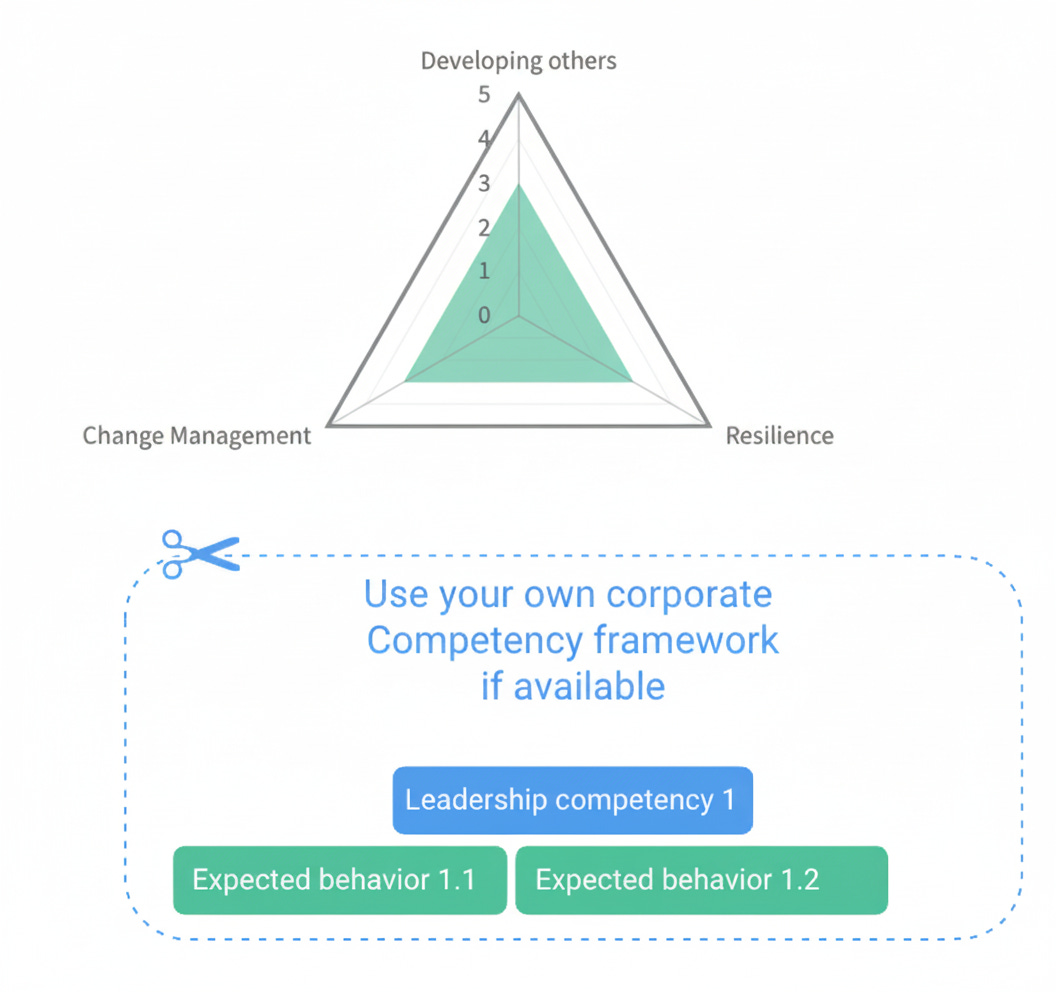
Ask yourself: what exactly do you want to train on? Several tools exist for this. I’m sharing mine here.
2. Space learning over 90 days
Instead of an information overload, effective programs follow a rhythm: one concept per week, one application task, one reflection.
Example:
Week 1: Learn goal-setting.
Week 2: Rewrite the team’s goals and share them.
Week 3: Get feedback from peers and adjust.
When managers practice using real situations, a goal conversation, a performance review, a team stand-up, the learning becomes visible. Their teams notice the improvement, and the new habits reinforce themselves.
Each week builds on the previous one. By the end of 90 days, they’ve practiced real skills multiple times in their own environment.
3. Practice in the flow of work with an accountability system
Stop pulling managers out of their jobs to learn how to manage. Let them learn inside the job itself, using your existing tools. Otherwise, they’ll develop a parallel approach that won’t fit your company.
To train them in the work, I emphasize embedding the learning principles of the program inside the performance management process. Train less, but embed the training in the performance system.
That way, there’s no choice but to deliver, monitor, and improve. It works because when expectations are tied to bonuses and salary increases, people suddenly take it way more seriously.
This requires us to train less and be selective about what we actually deliver. In my previous company, I implemented a Manager KPI. It took time to set up, but it worked to move the middle mass to actually perform their managerial duties and that’s what gives you the famous ROI of learning.
The last piece is follow-up. Weekly peer check-ins, short milestone reviews, and simple behavior tracking create gentle pressure to keep improving.
When managers share what worked, what failed, and what they’ll try next, development becomes social. HR can finally see change instead of guessing. And managers build confidence faster because they’re not learning alone.
Note: Use the performance management system as your accountability system. Leverage feedback loops using the managers of the managers. For managers who require extra care, use external coaching referencing the learning outputs of the program to iterate on results.
4. Evaluate the outputs of the implementation period
The evaluation can sit in:
Your normal performance management process: Assuming you’ve embedded leadership and manager development expectations into real outcomes (e.g., all staff have SMART goals and action plans, high potentials have at least one IDP, one-on-ones are performed quarterly, etc.).
A dedicated tool: If you want to avoid the big bang of setting a manager’s expectations (though I recommend it), use a separate tool to evaluate results after 90 days, six months, and one year — to measure progress versus the starting stage.
The shift
Here’s a mental reset that we, HR should adopt:
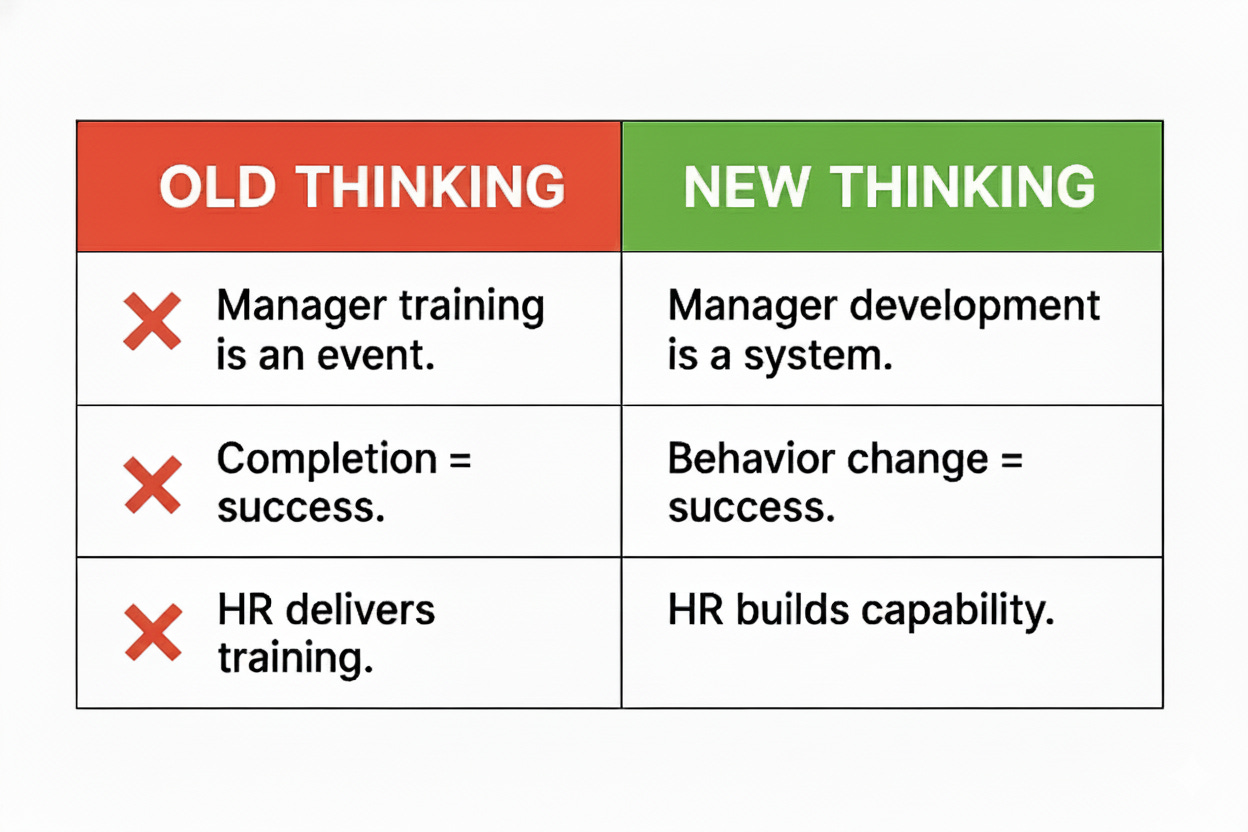
The companies with the best managers don’t have fancier slides or bigger budgets. They have better systems that understand people need repetition, relevance, and accountability to truly grow.
Once you see development that way, you stop asking “What training should we buy?” and start asking “What habits are we building, and how will we reinforce them over time?”
You can explore my Manager Development Program if you want to see how to turn your learning budget into real results.
Your wake up call?
So. Let me ask you:
When was the last time you checked if your manager training actually changed behavior?
What happens three weeks after your workshops end?
How many of your new managers are still applying what they learned?
Quick takeaway
By week 3, most manager training dies. Not because managers don’t care, but because the design sets them up to forget.
Fix the timing, space the learning, tie it to real work, and hold people accountable.
Do that, and you’ll finally have managers who don’t just attend training : they live it.

Is manager development your priority? Discover my Manager Development program.
My 90-Day Manager Development Program gives them practical training, tools, and mentoring across goals, feedback, performance, team development, and hiring with follow-up to ensure implementation and measurable results.